














1. Exchange Overview
Tapbit is a derivatives-focused crypto exchange that aims to keep things simple while still offering enough depth for active traders. It leans heavily into futures trading, with a clean interface and straightforward onboarding that does not overwhelm new users. At the same time, it avoids some of the clutter seen on larger exchanges, which makes it appealing for traders who just want to get in and execute without distractions.
One of Tapbit’s main selling points is its no-KYC model, which allows users to start trading quickly without submitting identity documents. This approach lowers the barrier to entry and aligns with the preferences of privacy-focused traders. However, it also shapes the rest of the platform, especially when it comes to fiat access and regulatory positioning.
The platform offers a mix of spot and futures markets, along with a small but growing selection of traditional finance instruments. While it does not compete with the largest exchanges in terms of sheer market variety, it covers the essentials well enough for most traders. Its inclusion of zero-fee trading pairs like BTC/USDT and ETH/USDT adds another layer of appeal for cost-conscious users.
Tapbit also experiments with features like copy trading, showing that it is trying to expand beyond basic trading. Still, it keeps its overall product lineup relatively lean. This makes it easier to learn but also means advanced users may find certain tools missing compared to more established platforms.
- No-KYC access with no IP checks.
- Competitive spot fees, including zero fees on BTC/USDT and ETH/USDT
- Clean and easy-to-use interface
- Futures trading is well integrated and functional
- Demo trading available for practice
- Basic copy trading feature for passive strategies
- No direct fiat on-ramps, only third-party options
- Weak P2P market with low activity
- Limited advanced trading tools and order types
- No fee discounts via token or referrals
- Lacks proof of reserves and detailed transparency
- Small selection of TradFi assets and Earn products
2. Fiat Deposits, Withdrawals and Fees
Tapbit doesn’t support direct fiat deposits or withdrawals. This means there are no (direct-to-exchange) options for bank transfers or credit cards. Instead, users must rely on third-party providers or peer-to-peer solutions to move between fiat and crypto.
3rd Party Gateways
For users who want a straightforward way to buy crypto with fiat, Tapbit integrates several third-party payment providers. These include Volet, Mercuryo, and Guardarian, which allow purchases using bank cards and other regional payment methods depending on availability.
 Visa/Mastercard
 SEPA Transfers (EU/EUR)
 SWIFT Transfers (International)
 Other Bank Transfers
 Google Pay
 Apple Pay
 Revolut Pay
These services act as intermediaries, meaning most fees are set by the providers rather than Tapbit itself. Costs can vary significantly based on payment method, currency, and region, often ranging from moderate to relatively high compared to direct fiat on-ramps. While convenient, these gateways are best used for smaller purchases or quick access rather than frequent transactions.
P2P Market
Tapbit does offer a peer-to-peer marketplace, which in theory allows users to trade directly with each other using local payment methods. This type of system can often provide better rates and more flexibility compared to third-party gateways.
In practice, Tapbit’s P2P market currently lacks active merchants and liquidity. Listings are sparse, and it can be difficult to find reliable counterparties for trades. Because of this, the P2P feature is not suitable for most users at this time, and those seeking P2P trading are better off using more established platforms with deeper liquidity.
3. Trading Markets and Fees
Crypto Trading Markets
Tapbit supports several core market types, covering both crypto-native and a limited set of traditional assets:
- Spot Trading: Spot markets allow users to buy and sell cryptocurrencies directly, with immediate settlement. Tapbit offers a modest selection of trading pairs, including all major assets and a few hundred medium-sized and low-cap altcoins, making it suitable for basic portfolio building and simple trades.
- Futures Trading: This is Tapbit’s strongest area, offering perpetual futures contracts with up to 150x leverage. Traders can go long or short on major cryptocurrencies, with relatively smooth execution and a user interface designed for active trading. Liquidity is generally stronger here than on spot markets.
- TradFi Markets: The exchange includes a small selection of traditional financial instruments such as stocks and commodities. The offering is fairly basic and does not rival top exchanges that deeply integrate TradFi, but it’s still a useful addition for users who want limited exposure without leaving the platform.
Tapbit doesn’t currently offer Margin trading, Options markets, or any on-chain trading features. This keeps the platform simpler but also limits potential options for advanced strategies.
Trading Fees
Tapbit is generally a low-cost exchange, particularly on the spot side:
- Spot trading fees are set at 0.1% for both makers and takers, which places it among the cheaper platforms in the industry.
- Futures trading fees are 0.02% for makers and 0.06% for takers. These rates are in line with industry averages and remain competitive for most traders, especially those who rely on frequent order execution.
A notable advantage is the zero-fee spot trading available on BTC/USDT and ETH/USDT pairs1. Traders who focus primarily on these two markets can effectively trade without paying any spot fees, which makes Tapbit particularly attractive for simple strategies centered around major assets.
Tapbit does offer a VIP program2, but it differs from most competitors. The first VIP level requires either 10 million USDT in futures trading volume or maintaining an average account balance of $10,000 over 30 days. Instead of reducing trading fees, VIP perks focus on benefits like funding bonuses, liquidation subsidies, and promotional rewards.
There is no native exchange token and no referral fee rebate available. As a result, users have very limited ways to reduce trading fees beyond the base rates, which may be a downside for high-volume traders used to stacking discounts elsewhere.

Other Trading Features
- Copy Trading: Users can follow and replicate the strategies of other traders. This feature is aimed at beginners or those who prefer a more passive approach, although results depend heavily on the performance of selected traders.
- Demo Trading: A demo environment is available, enabling users to practice trading without risking real funds. This is especially helpful for beginners learning how futures markets work.
- Optional KYC: Tapbit doesn’t require identity verification for any features aside from fiat deposits. Unverified users can access all crypto trading markets and staking regardless of their location. Without ID verification, users can withdraw up to 2 BTC worth of crypto every 24 hours.
- Signup Bonuses: A total of $5,000 in welcome rewards are available to new customers, in the form of trading bonuses3. These trading bonuses can be used as position margin, and to pay transaction and funding fees (although the rules mentioned on their website have conflicting reports about fee usage). Bonuses can’t be directly withdrawn, but profits can.
Tapbit doesn’t have recurring or scheduled purchases, subaccounts, and its only trading bot (Grid) has been removed4. These omissions reinforce its positioning as a simpler, derivatives-focused exchange rather than a full-featured trading ecosystem.
4. User Experience
Tapbit delivers a fairly straightforward user experience that prioritizes simplicity over deep customization. The platform feels clean and uncluttered, which helps reduce friction for new users. At the same time, it lacks some polish and flexibility in certain areas, especially outside of its trading interfaces.
Overall User Experience
The general layout is intuitive, with clearly separated sections for markets, trading, and account management. Navigation is simple, and most features are easy to find without digging through menus. This makes onboarding relatively smooth, even for users with limited experience.
The mobile app mirrors the desktop experience closely, offering consistent functionality across devices. Performance is stable, and execution speeds are acceptable for most trading styles. However, customization options are limited, and the main account interface does not offer a dark mode, which can be slightly disappointing to some users. Some parts of the platform lean too heavily into the branded yellow color, leading to low contrast issues.
Educational content is minimal, with only basic guides available. Users looking for in-depth tutorials or advanced trading education will need to rely on external resources rather than the platform itself.
Trading User Interface
Tapbit’s trading interface is functional but somewhat uneven between spot and futures markets. The spot trading screen is very basic, with very limited customization options and a layout that cannot be adjusted significantly. It gets the job done but may feel restrictive for experienced traders.
The futures interface is noticeably better, offering more flexibility in layout and tools. Users can adjust chart settings, manage positions more efficiently, and move and resize various panels without friction. This is expected given the platform’s focus on derivatives trading.
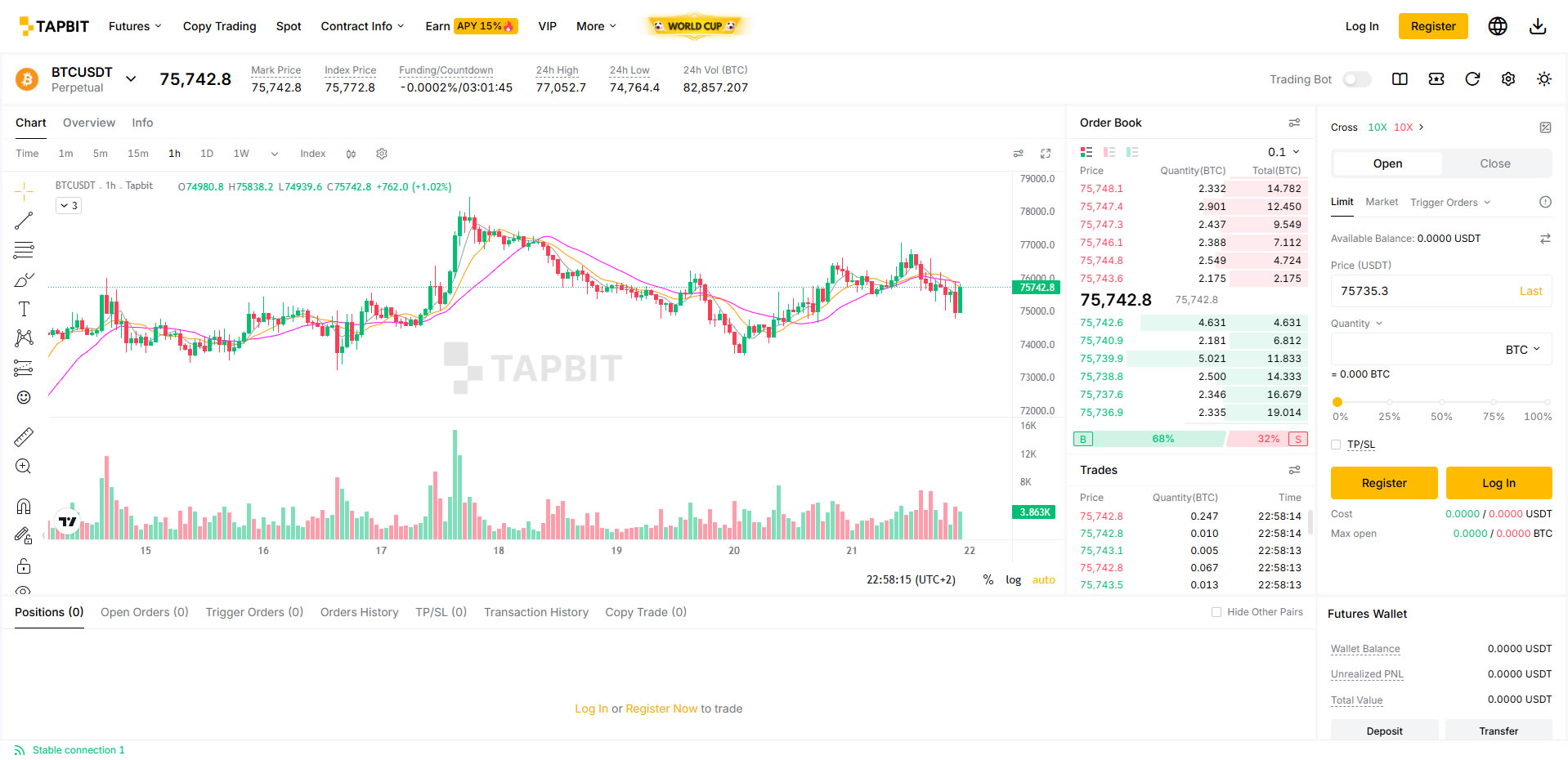
Order types are limited to standard options such as limit, market, and basic trigger orders. More advanced order types like iceberg, TWAP, or OCO are not available, which may limit strategy execution for professional traders.
Customer Support Channels
Tapbit provides a basic set of support channels, including email support and a ticketing system. Response times are generally acceptable, though not particularly fast during peak periods. There is no phone support or live chat, which is typical for exchanges of this size.
The help center5 exists but is quite limited in scope. Articles cover only the basics, such as account setup and simple trading actions, and lack detailed explanations or troubleshooting depth. Users dealing with more complex issues may find the documentation insufficient.
Social media channels are present and occasionally used for announcements and updates. However, they are not a reliable substitute for direct customer support when urgent issues arise.
Supported Languages
Tapbit supports multiple languages, making it accessible to traders around the globe.
Currently supported languages (11):
The platform interface is available in several widely used languages, though translation quality can vary slightly. Help center is only available in English.
5. Safety & Security
Company Info and Overview
Tapbit operates as an offshore crypto exchange with a focus on derivatives trading without KYC requirement. Like many platforms in this category, it maintains a relatively low public profile when it comes to corporate structure and leadership transparency.
Company CEO since 2026 is Milton Cogo6, but overall there is limited publicly available information about the founders, executives or headquarters, which may concern users who prioritize transparency. This is not unusual for no-KYC exchanges, but it does place more importance on the platform’s operational track record and user trust.
The exchange has been operating without major public controversies or widely reported incidents, which is a positive sign. Still, the lack of detailed corporate disclosures or comprehensive regulatory approvals or licensing means users need to rely more on observed performance than formal assurances.
Regulatory Compliance and Licenses
Tapbit holds basic MSB (Money Services Business) registrations in United States and Canada, along with a forex/crypto license in St. Vincent and the Grenadines7. These registrations provide a minimal level of legal recognition but do not equate to full regulatory oversight.
Because Tapbit allows users to trade without mandatory KYC, obtaining comprehensive licenses in stricter jurisdictions is not even possible. This is a common trade-off among no-KYC exchanges, where accessibility comes at the cost of regulatory approvals.
As a result, users should not expect the same level of consumer protection found on fully regulated platforms. While this setup is typical for offshore exchanges, it does mean that legal recourse may be limited in case of disputes.
Available and Restricted Countries
Tapbit is accessible in most parts of the world8, and this broad availability is one of the advantages of its no-KYC approach.
Tapbit is available in a total of 185 countries, and restricts users from 40 countries. Restricted countries include Albania, Algeria, Austria, Azerbaijan, Bangladesh, Bosnia & Herzegovina, Chad, China, Cote d’Ivoire, Croatia, Cuba, Czechia, Ecuador, Egypt, France, Greece, Hong Kong, Hungary, India, Iran, Iraq, Japan, Morocco, Myanmar, Nepal, Nigeria, North Korea, Norway, Oman, Pakistan, Romania, Sahrawi, Slovakia, St. Martin, Thailand, Tunisia, Uganda, United States, Uruguay, and Yemen.
Restrictions used to mainly apply to high-risk, highly regulated, or sanctioned jurisdictions, but have been expanded to a few countries that aren’t commonly restricted from crypto trading. Users in most restricted countries are usually able to access the platform (Tapbit is fairly VPN-friendly as well), but they won’t be able to complete identity verification.
Even in supported countries, users are responsible for ensuring compliance with local laws. The platform’s accessibility does not necessarily mean it’s fully authorized in every jurisdiction where it can be accessed.
Platform and Funds Safety
Tapbit implements standard security practices such as cold storage for the majority of user funds. Keeping assets offline reduces exposure to hacking attempts and is considered a baseline requirement for modern exchanges.
The exchange has a $50 million USDT insurance fund9, guaranteeing users get their losses reimbursed in case of platform-related issues. However, despite having a Proof of Reserves (PoR) page10, the platform provides no actual proof of any reserves. The initial PoR report was published in 2024, but no reports have been made public since then.
There is also no clear information about external audits or formal security certifications. That being said, the company has collaborations with CertiK11 and Hacken12 for independent auditing and security monitoring.
There have been no widely reported major hacks or breaches involving Tapbit so far. While this is encouraging, the absence of transparency around internal security processes means users must take some of these claims on trust.
User Account Security
Tapbit offers a solid range of account-level security features designed to prevent unauthorized access. These include two-factor authentication through Google Authenticator, as well as email and SMS verification options.
Additional protections include withdrawal whitelists, withdrawal PIN codes, anti-phishing codes, and device management tools. These features help users secure their accounts against common attack vectors such as phishing and credential theft.
When properly configured, these security measures are sufficient to prevent most account compromises. However, as always, the effectiveness depends heavily on user behavior and adherence to best security practices.
Is Tapbit Safe or Unsafe?
Tapbit falls into the middle category when it comes to safety. It offers the essential technical safeguards expected from a modern exchange, along with a clean operational record and no major known security incidents.
At the same time, it lacks transparency in areas that more cautious users tend to value. The absence of proper proof of reserves, detailed audits, and strong regulatory oversight introduces a level of uncertainty that cannot be ignored.
For experienced traders who are comfortable using offshore, no-KYC platforms, Tapbit can be considered reasonably safe when proper precautions are taken. However, users seeking maximum protection, regulatory backing, and full transparency may find it less reassuring than top-tier exchanges.
6. Conclusion
Tapbit keeps things simple and focused, which will appeal to a specific type of trader. It does not try to compete on sheer feature count, but instead offers a clean environment for derivatives trading with low spot fees and easy onboarding. For many users, that simplicity is exactly the point.
At the same time, the platform shows its limits once users look beyond core trading. Some missing tools, limited fiat options, and modest transparency mean it will not satisfy everyone. Still, for what it sets out to do, Tapbit performs reasonably well.
Who It’s Best For (and Not For)
- Beginner traders who want a simple, low-barrier entry into crypto trading
- Active traders focused on futures markets
- Users who prefer no-KYC exchanges
- Traders who mainly use BTC/USDT and ETH/USDT spot pairs
- Users who need direct fiat deposits and withdrawals
- Advanced traders looking for complex order types and tools
- Passive investors seeking automated investing features or comprehensive staking
- Users who prioritize strong regulation and transparency
Final Verdict
Tapbit works perfectly fine as a derivatives trading platform, but not so much as a full-service crypto ecosystem. It delivers a smooth experience for futures traders and keeps costs low on spot markets, especially with its zero-fee pairs. For users who value simplicity and quick access, that combination is hard to ignore.
However, the exchange’s limitations become more obvious with prolonged use. The absence of advanced tools, deeper liquidity across all markets, and meaningful fee reduction mechanisms may push experienced traders elsewhere. It feels more like a solid secondary exchange than a primary trading hub.
Safety sits in a reasonable middle ground. There are no major red flags, but also not enough transparency to fully compete with top-tier exchanges. Users should approach it with standard precautions, especially when holding larger balances.
In the end, Tapbit is a fine option for customers who need Futures trading without restrictions or KYC requirements, and don’t care about any extra features. It’s not trying to be a full financial center, and that works in its favor, as long as expectations stay realistic.
Sources and references:
- Fees (Spot & Derivatives) – https://tapbitcex.zendesk.com/hc/en-us/articles/12198533844879-Fees-Spot-Derivatives ↩︎
- VIP Level Benefits – https://www.tapbit.com/en/vip/level-benefits ↩︎
- Rules for using Trading Bonus – https://tapbitcex.zendesk.com/hc/en-us/articles/12198943235471-Rules-for-using-Trading-Bonus ↩︎
- Trading bots discontinuation notice – https://tapbitcex.zendesk.com/hc/en-us/articles/16860777634959-Trading-Bots-Service-Discontinuation-Notice-2026-07-30 ↩︎
- Tapbit Exchange Help Center – https://tapbitcex.zendesk.com/hc/en-us ↩︎
- Annoucement of the Appointment of Milton Cogo as CEO of Tapbit – https://tapbitcex.zendesk.com/hc/en-us/articles/15788732609295-Announcement-on-the-Appointment-of-Milton-Cogo-as-CEO-of-Tapbit ↩︎
- Licenses and registrations – https://blog.tapbit.com/tapbit-strengthens-global-compliance-framework-under-ceo-leadership-reinforcing-user-trust/ ↩︎
- Location Restrictions – https://tapbitcex.zendesk.com/hc/en-us/articles/12197830391439-Location-Restrictions ↩︎
- Tapbit’s Commitment to Platform Security (Insurance fund) – https://tapbitcex.zendesk.com/hc/en-us/articles/12196970166415-Tapbit-s-Commitment-to-Platform-Security ↩︎
- Tapbit Proof of Reserves – https://www.tapbit.com/en/proof-of-reserves ↩︎
- CertiK collaboration – https://blog.tapbit.com/tapbit-strengthens-security-framework-through-strategic-collaboration-with-certik/ ↩︎
- Hacken collaboration – https://blog.tapbit.com/is-tapbit-safe-tapbit-strengthens-security-framework-through-strategic-collaboration-with-hacken-audit/ ↩︎

All reviews submitted are moderated. Negative opinions are fine. Spam, competitor promotion, false claims, FUD or unsubstantited criticism is not approved.