













1. Exchange Overview
Pionex built its platform around one simple idea: automate trading without making users jump through hoops. It launched in 2019 and quickly carved out a niche by offering built-in trading bots at no extra cost, which still feels rare in a market where automation tools often sit behind paywalls. Instead of pushing users toward external integrations, the platform keeps everything in-house, and that design choice defines most of its appeal.
The exchange leans heavily into simplicity, but not at the expense of depth. Beginners can start with pre-configured strategies, while more experienced traders can tweak parameters or even build their own bot logic. This dual approach works well because it removes the usual friction tied to algorithmic trading, yet still leaves room for experimentation. It feels less like a traditional exchange and more like a toolkit for automated strategies.
Liquidity is another strong point, since Pionex aggregates liquidity from larger exchanges like Binance and HTX. That setup helps maintain tighter spreads and more consistent order execution, even during volatile market conditions. While it does not operate at the same scale as top-tier centralized exchanges, the trading experience rarely feels thin or illiquid.
Fees are where Pionex quietly outperforms much of the competition. The platform offers some of the lowest spot trading fees in the industry, which becomes especially important for bot users running high-frequency strategies. When automation meets low fees, the result is a platform that encourages active use rather than passive holding.
- Very low spot trading fees at 0.05%
- Built-in trading bots and automation tools
- Simple and beginner-friendly interface
- No mandatory full KYC for basic trading access
- Aggregated liquidity improves slippage
- Demo trading available for strategy testing
- Limited transparency around security and reserves
- No margin trading, copy trading, or advanced order types
- Basic account-level security features
- Fiat withdrawals depend on third-party providers
- No crypto loans or broader financial services
- Limited regulatory coverage
2. Fiat Deposits, Withdrawals and Fees
Direct Payments
Pionex supports several direct fiat payment methods, making it relatively easy to fund an account without relying entirely on crypto transfers. Users can deposit using bank cards, SEPA transfers, Faster Payments, and PIX, which covers a broad international user base.
| Payment method | Supported currencies | Deposit fee | Withdrawal fee |
|---|---|---|---|
| Visa and Mastercard | Any supported | 1.2% EEA, 2.6%-2.8% other countries | Not available |
| SEPA bank transfer | EUR | Free | Not available |
| Faster Payments bank transfer | GBP | Free | Not available |
| PIX | BRL | 4 BRL | Not available |
Fiat withdrawals, however, are not handled directly by the platform. Instead, users must rely on third-party payment providers to convert crypto back into fiat and withdraw funds. This adds an extra step and may introduce additional fees, which slightly reduces the convenience compared to fully integrated exchanges.
3rd Party Gateways
To bridge the gap between crypto and fiat, Pionex integrates several well-known third-party gateways including Volet, Simplex, Banxa, and Alchemy Pay. These services allow users to buy crypto using traditional payment methods, but fees can vary significantly depending on the provider and payment type. In most cases, card purchases come with higher fees, while bank transfers tend to be more cost-efficient.
 Visa/Mastercard
 SEPA Transfers (EU/EUR)
 SWIFT Transfers (International)
 ACH Transfers (US/USD)
 Google Pay
 Apple Pay
 Other Bank Transfers
 Skrill
 Neteller
While these gateways expand payment methods, they also introduce inconsistency in pricing and user experience. Each provider has its own fee structure, processing time, and KYC requirements, which means users need to compare options before completing transactions. It works, but it is not as seamless as native fiat infrastructure.
It is also worth noting that Pionex does not offer a peer-to-peer marketplace. Users cannot directly trade fiat with other users, which removes one alternative route for deposits and withdrawals that some competitors provide.
3. Trading Markets and Fees
Crypto Trading Markets
Pionex keeps its market structure relatively focused, but still manages to cover most core trading needs.
- Spot: The spot market is the backbone of the platform, offering a wide selection of crypto pairs along with tokenized stocks. Trades are executed instantly at market prices or through limit orders, making it suitable for both manual and bot-driven strategies.
- Futures: The futures market allows users to trade perpetual contracts with leverage, including crypto pairs and select traditional finance instruments like stock indices and commodities. This adds options for traders looking to hedge or speculate on price movements without owning the underlying asset.
- Onchain: There is no onchain trading functionality, meaning users cannot interact with decentralized finance protocols directly through the platform.
- TradFi: Pionex includes tokenized exposure to traditional financial assets such as stocks, indices, and commodities. However, it does not support forex trading, which limits its reach compared to broader multi-asset platforms.
The platform also lacks margin trading, copy trading, and onchain integrations, which keeps things simpler but less versatile for advanced users. It also doesn’t offer Options trading, which may disappoint advanced derivatives traders looking for more complex strategies.
Trading Fees
Pionex is a real gem with its spot trading fees. Both maker and taker fees are set at just 0.05%, which is roughly half of what many low-cost exchanges charge. This pricing is particularly attractive for bot users who execute frequent trades and need to minimize cost drag over time.
Leveraged token fees are 0.10%, even though they are traded on spot market.
Futures trading fees are more in line with the industry standard. Maker fees sit at 0.02%, while taker fees are 0.05%, which is competitive but not groundbreaking. These rates are reasonable for leveraged trading and align with what most major platforms offer.
By using our exclusive coupon code, users can permanently reduce all spot, future and bot fees by 5%.

VIP tiers are also available1, but they are not particularly accessible for smaller traders. The volume requirements are in the millions, meaning most users will remain on the base fee structure. There are also no native token discounts, which simplifies the fee model but removes one potential way to reduce costs further.
All trading fees are transparently and clearly outlined on the Transaction Fees page on Pionex website.
Other Trading Features
Pionex adds a few extra tools that shape the overall trading experience:
- Demo trading: Available for users who want to test strategies without risking real funds. This is especially useful for learning how bots behave in different market conditions.
- Trading bots: The platform offers an impressive suite of 16 built-in bots, such as grid trading, DCA, rebalancing, infinity grid, and TWAP strategies. Users can also create AI-assisted strategies, which lowers the barrier for those unfamiliar with algorithmic trading.
- Leveraged tokens: These provide exposure to leveraged positions without the need to manage margin or liquidation risks manually. They are simpler than futures but still carry inherent volatility.
- Optional KYC: Pionex operates with a light KYC approach. Users can access trading features after providing basic personal information (name and location) without submitting documents. Without full verification, daily withdrawals are capped at $20,000 and monthly at $100,000, which feels reasonable for smaller traders but restrictive for high-volume users. Fiat functionality, however, will require full ID verification.
At the same time, some features are notably missing. There are no recurring or scheduled purchases, no copy trading functionality, and no subaccounts for managing multiple strategies or users.
4. Other Features and Services
Pionex keeps its feature set focused, but it still includes a few extras that go beyond basic trading. The platform clearly prioritizes automation and simplicity over building a full financial ecosystem. As a result, some commonly expected services are missing, while others feel streamlined but limited.
- Staking: Pionex offers basic staking options, allowing users to earn passive rewards on selected cryptocurrencies. The selection is not as broad as dedicated staking platforms, but it works well for users who want simple yield opportunities without leaving the exchange. Returns are generally modest, and the feature feels more like a bonus than a core offering.
- ATM Card: Visa (personal) or Mastercard (corporate) cards are available, offering 1% cashback for everyday spending. The cards only come in virtual editions, but can be added to mobile wallets like Google or Apple for physical purchases.
The platform does not support crypto loans, so users cannot borrow against their holdings or earn interest through lending. It also lacks gift cards or crypto gifting features, which some exchanges use to attract casual users. Overall, the secondary and financial service layer feels minimal, but it aligns with Pionex’s focus on trading rather than becoming an all-in-one crypto hub.
5. User Experience
Pionex leans into a clean and functional design that favors usability over visual flair. The platform feels consistent across desktop and mobile, with a layout that keeps core tools within easy reach. It does not overwhelm new users, but experienced traders may notice the lack of deeper customization options.
Overall User Experience
The interface is straightforward and easy to understand, even for those new to crypto trading. Navigation is logical, and the onboarding process does a decent job of guiding users toward key features like trading bots. There are helpful tutorials and explanations throughout the platform, which reduce the learning curve for automated strategies.
Customization options are somewhat limited, but the essentials are there. Users can adjust layouts, manage dashboards, and switch between views without much friction. The entire interface, not just the trading terminal, is available in dark mode, which is a small but appreciated detail for long sessions.
Trading User Interface
The trading interface focuses on clarity rather than complexity. Order placement is simple, with support for standard order types like market and limit orders, but it does not go deep into advanced conditional orders. This keeps things accessible, though it may frustrate traders looking for more control.
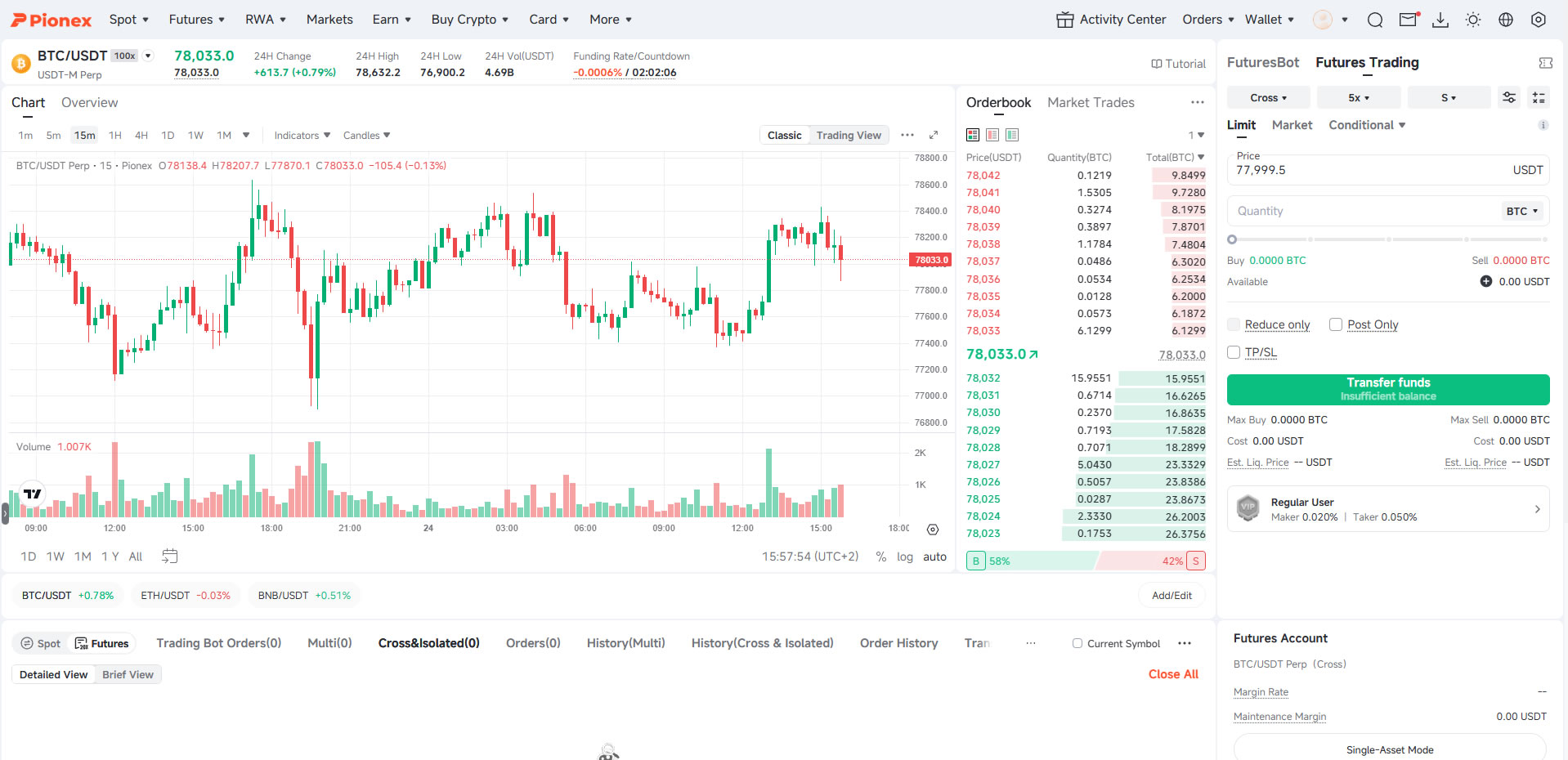
Charting tools are solid, with native version or powered by Tradingview. They cover the basics well enough for most strategies, especially when combined with automated bots. Interface customization is very good, which reinforces the platform’s beginner-friendly approach.
Customer Support Channels
Customer support is available through a ticketing system and email, which handle most user inquiries. There is also a help center with guides and FAQs that cover common issues and platform features. Live chat support is available, though response times can vary depending on demand.
The platform maintains a presence on social media channels, where users can find updates and announcements. However, there is no phone support, which may be a drawback for users who prefer direct communication during urgent issues.
Supported Languages
6. Safety & Security
Company Info and Overview
Pionex operates as a relatively young exchange, having launched in 2019. It’s a globally accessible platform, though detailed corporate structure and leadership information are not heavily emphasized on its website. This lack of transparency is not unusual for smaller exchanges, but it does leave some gaps for users who prefer clear company disclosures.
The exchange has managed to build a solid user base over the years, largely driven by its trading bots and low fees. Daily trading volumes are respectable, which suggests active usage and a certain level of trust from the community. Longevity in the crypto space matters, and surviving multiple market cycles does add credibility.
Still, the company does not present itself with the same level of openness as larger, heavily regulated exchanges. Users who value corporate transparency may find this aspect lacking, even if the platform itself functions reliably.
Regulatory Compliance and Licenses
Pionex holds a Money Services Business (MSB) registration in the United States. This is a basic regulatory step that allows it to operate certain financial services, but it does not carry the same weight as full exchange licensing. There are no major regulatory approvals in regions like Europe or the UK.
This limited regulatory footprint is largely tied to its low-KYC model. Platforms that allow trading with minimal identity verification can’t meet stricter compliance standards. In that sense, the low licensing situation is expected rather than surprising.
For users, this creates a trade-off. On one hand, there is more privacy and easier onboarding. On the other, there is less regulatory oversight and fewer protections compared to fully licensed exchanges.
Available and restricted countries
Pionex is available in many countries worldwide, but there are notable restrictions in certain regions due to regulatory requirements. Users from jurisdictions with strict crypto regulations may find limited access or complete restrictions when attempting to use the platform.
Pionex is available in a total of 203 countries, and restricts users from 22 countries. Restricted countries include Afghanistan, Canada, Central African Republic, China, Congo - Kinshasa, Cuba, Iran, Lebanon, Libya, Netherlands, North Korea, Singapore, Somalia, South Sudan, Spain, Sudan, Syria, United Kingdom, United States, Venezuela, Yemen, and Zimbabwe.
Before registration customers should confirm whether Pionex allows or restricts their country.
Platform and Funds Safety
Pionex homepage states that it uses standard security practices such as cold storage for the majority of user funds. This is an industry baseline and helps reduce exposure to online threats. However, detailed breakdowns of custody methods or wallet infrastructure are not publicly disclosed.
Proof of Reserves reports are published weekly, but only accessible to logged-in users2. There is limited information about third-party audits or insurance coverage for user funds. Without clear data about some of these safety protocols, users are left to rely on reputation rather than verifiable safeguards.
There are no widely reported major hacks associated with the platform, which is a positive sign. It does have a bug bounty program3, but still the absence of detailed security disclosures and audit reports raises a few valid concerns about overall fund protection.
User Account Security
Account-level security on Pionex covers the basics but does not go much further. Users can enable two-factor authentication, set anti-phishing codes, and manage recognized devices. These features help protect against common threats like phishing and unauthorized logins.
However, more advanced protections are missing. There is no dedicated trading password, no fund password for withdrawals, and no withdrawal address whitelist. Passkeys are supported, but some of the mentioned advanced account safety measures are not, which puts this one slightly behind more security-focused platforms.
As a result, account security feels average at best. It covers essential protections, but lacks the layered defenses that more cautious users may expect.
Is Pionex Safe or Unsafe?
Pionex sits in a middle ground when it comes to safety. It has been operating since 2019 without major public security incidents, and its steady trading volume suggests a level of user trust. The platform’s simplicity and focus on core features also reduce potential attack surfaces compared to more complex ecosystems.
At the same time, the lack of transparency is hard to ignore. Limited information about fund storage, audits, and insurance creates uncertainty, especially for users holding significant balances. Regulatory coverage is also minimal, which means fewer external safeguards.
Overall, the exchange can be considered reasonably safe for smaller balances and active trading, and there’s no reason to suggest otherwise. For larger holdings, the combination of limited disclosures and basic security features should push more cautious users toward better-documented alternatives.
7. Conclusion
Pionex keeps things simple and leans hard into automation. It does not try to be everything, and that’s perfectly fine. Traders who want low fees and built-in bots will feel right at home, while others who expect a full financial ecosystem may notice the missing extras pretty quickly.
The exchange’s biggest strength is consistency. It delivers exactly what it promises, without unnecessary complexity or distractions. Still, the trade-offs around features, transparency, and security should not be ignored.
Who It’s Best For (and Not For)
Pionex works best for a specific type of user. It knows its audience and does not pretend otherwise.
- Beginners: Simple interface and ready-made bots make starting easy without much trial and error.
- Active traders: Very low spot fees and solid execution help keep costs down over time.
- Passive investors: Works well for those using trading bots or basic staking for hands-off strategies.
- Privacy-focused users: Light KYC requirements appeal to users who prefer minimal verification.
- Advanced traders: Missing features like margin trading, options, and deeper tools can feel limiting.
- High-net-worth users: Limited transparency and weaker security features may raise concerns for larger balances.
Final Verdict
Pionex feels like a specialist rather than a generalist. It focuses on automated trading and executes that idea better than most competitors. The built-in bots are not just a gimmick, they are genuinely useful and accessible, which gives the platform a clear identity.
Fees are another major win. The spot trading cost alone makes it appealing for frequent traders, especially those running grid or DCA strategies. Over time, that difference adds up and can noticeably improve overall returns.
At the same time, the platform cuts corners in areas that matter to more cautious users. Security transparency is limited, and account protections feel basic compared to industry leaders. For smaller balances, this may not be a dealbreaker, but it becomes more relevant as funds grow.
In the end, Pionex works best as a trading tool rather than a long-term storage solution. It is efficient, easy to use, and cost-effective, but it does not offer the depth or reassurance needed to fully replace larger, more established exchanges.

All reviews submitted are moderated. Negative opinions are fine. Spam, competitor promotion, false claims, FUD or unsubstantited criticism is not approved.