











1. Binance Overview
Binance launched in 2017 and quickly turned into the biggest crypto exchange by trading volume. It was founded by Changpeng Zhao, often called CZ, who built it with a strong focus on speed, low fees, and a massive selection of assets. The platform started as a crypto-only exchange but didn’t stay in that lane for long.
Today, Binance feels more like a full financial ecosystem than a simple exchange. Users can trade hundreds of cryptocurrencies, stake assets, borrow funds, and even spend crypto with cards in supported regions. It blends beginner-friendly tools with advanced trading features, which sounds great on paper, but it can feel overwhelming at first glance.
Still, Binance keeps pulling users in for three main reasons: liquidity, variety, and pricing. It offers deep order books across most major pairs, meaning trades execute fast and with minimal slippage. Add relatively low fees and constant product expansion, and it’s easy to see why it dominates globally, even with ongoing regulatory scrutiny.
- Low trading fees, especially with BNB discounts
- Big selection of cryptocurrencies and trading pairs
- Deep liquidity across spot and derivatives markets
- Wide range of features beyond trading, including staking and loans
- Advanced tools for experienced traders, including bots and subaccounts
- Global availability with diverse fiat on-ramps and P2P options
- Interface can feel overwhelming, especially for beginners
- Some advanced trading features carry high risk for beginners, especially leveraged products
2. Fiat Deposits, Withdrawals and Fees
Binance supports some of the most diverse payment methods in the industry. Direct payment methods ensure users can buy crypto with minimum costs and friction, without having to rely on intermediaries. In other cases, users can rely on third-party services or peer-to-peer trading.
Direct Payments
Direct fiat deposits are the cleanest option when available. Users can fund their account using bank transfers, credit cards, or debit cards, depending on local support.
| Payment method | Supported currencies | Deposit fee | Withdrawal fee |
|---|---|---|---|
| Visa and Mastercard | Any supported | 2% | 2% |
| Google Pay | Any supported | 2% | Not available |
| Apple Pay | Any supported | 2% | Not available |
| Mobile Money | Any supported | 1% | 1% |
| ACH bank transfer | USD | $1 (US only) | Not available |
| SEPA bank transfer | EUR | No fee | €1 |
| SWIFT bank transfer | Any supported | Min. €0.5, max. 1.2% | €1 - €5 (max. $25) |
| Faster Payments bank transfer | GBP | 1 GBP | 2 GBP |
| PIX | BRL | No fee | 3.5 BRL |
| Revolut | Any supported | 2% | Not available |
| PayPal | Any supported | 2% (EUR only) | €2 |
| Zen | Any supported | 1% to 1.2% | 0% |
Bank transfers usually come with the lowest fees, and sometimes none at all. However, processing times vary. SEPA transfers in Europe are instant and cheap, while international wires can take days and cost more.
Card payments are instant, which sounds convenient, but the fees are noticeably higher. It’s common to see charges around 2% or more, depending on the currency and region. However, most competitors charge either same or higher fees.
Withdrawals follow a similar pattern. Bank withdrawals are cheaper but slower, while card withdrawals are faster but cost more. Limits and availability can shift based on regulation, which means users should double-check before relying on a specific method.
3rd Party Gateways
When direct fiat rails aren’t available, Binance plugs into third-party providers. These gateways act as middlemen. They process the fiat transaction and deliver crypto directly to the user’s Binance wallet.
 Visa/Mastercard
 ACH Transfers (US/USD)
 SEPA Transfers (EU/EUR)
 Google Pay
 Apple Pay
 SWIFT Transfers (International)
 PayPal
 Skrill
 Neteller
Fees through gateways are typically higher than direct deposits, usually from 3% to 5%. Exchange rates can also carry a spread, which quietly adds to the expense. On the upside, these 3rd party services expand payments to local methods in many countries.
P2P Market
Local bank transfers, mobile apps or QR-based payment systems not natively supported by the exchange will be available on Binance’s P2P market, because it’s the most active P2P marketplace in the industry. There are hundreds of sellers in every country, ensuring lowest spreads and fees. Practically any payment method imaginable (including cash) will be available on P2P.
Fees are one of the biggest advantages here. Binance itself doesn’t charge trading fees on P2P transactions. However, sellers usually bake their profit into the price, so users still pay indirectly.
Security relies on an escrow system. Binance holds the crypto until the payment is confirmed, reducing the risk of fraud. That said, users still need to be cautious. Reputation scores, trade history, and verified status matter a lot in this environment.
P2P often becomes the go-to method in regions with strict banking rules or limited crypto access. It’s widely used, but it requires more attention and trust compared to standard deposits.
3. Crypto Trading Markets and Fees
Binance covers almost every type of crypto market a trader could want. That range is one of its biggest selling points, though it can feel like overkill for casual users.
- Spot Market: The spot market is the standard buy and sell environment. Users trade cryptocurrencies at current market prices, with real ownership of the assets. Binance offers 600+ spot pairs, including major coins and smaller altcoins, all backed by deep liquidity.
- Margin Market: Margin trading lets users borrow funds to increase position size. Binance supports both cross and isolated margin, and leverage up to 5x. It’s useful for experienced users, but losses can stack up quickly if trades go wrong.
- Futures Market: Binance Futures is one of the most active derivatives platforms in crypto. It offers perpetual and quarterly contracts with up to 150x leverage. More than 600 trading pairs are available, nearly all of which have excellent volume and liquidity.
- Options Market: Options trading on Binance is more limited compared to futures but still available. Users can trade contracts that give them the right, not the obligation, to buy or sell assets at a set price. It’s mostly used by advanced traders looking to hedge or build complex strategies.
- Onchain / Web3 Trading: Binance has been pushing into decentralized finance through its Web3 wallet. This allows users to interact with onchain markets, swap tokens, and access DeFi protocols directly. It’s a bridge between centralized convenience and decentralized control.
- TradFi Integration: Binance has more than 7,000 real stocks (like regular brokers, giving you full ownership of real equity). In addition, other traditional market listings include tokenized assets on spot market, while derivatives has stocks, indices, commodities and forex pairs (bStocks1, xStocks, and Ondo RWAs).
Trading Fees
Binance built its reputation on low fees, and it still competes aggressively on pricing:
- Spot trading fees are 0.1% per trade, for all order types.
- Futures fees start at 0.02% for maker and 0.05% for taker orders.
These base rates2 already sit below many competitors, but can drop even further. Traders who hit higher volume tiers or hold large BNB balances get discounted rates through VIP program, so high-frequency traders benefit the most here.
Holding and using the native token BNB unlocks another layer of discounts. Users can pay fees with BNB to reduce costs by 25% on spot or 10% on futures. Any amount of BNB is sufficient to get discounted fees, as long as it’s enough to cover your trading fee.
Referral programs also cut spot fees. Users who sign up through referral links can get 5% fee discount applied to their account, which also stacks with other reductions. To receive this fee discount users can use code “5FEEDISCOUNT” during signup.

Unlike some major competitors, Binance doesn’t abuse its reputation or brand to charge users with high fees. It goes the opposite direction, ensuring users can trade both fiat and crypto with minimal costs.
Other Trading Features
Binance stacks extra tools on top of its core markets, aiming to cover every trading style.
- Demo Trading: Futures testnet allows users to practice with simulated funds. It’s useful for learning leverage without risking real money.
- Copy Trading: Users can automatically mirror trades from experienced traders. It lowers the barrier for beginners, though results depend heavily on who they follow.
- Convert: Quick conversions are available for instant currency swaps between fiat or crypto assets. Convert skips all complexity and regular spot trading interface, making it perfect for complete beginners who simply want to swap assets without a learning curve.
- Recurring / Scheduled Purchases: Automated buying strategies can be set up with custom amounts and intervals. Users can set up regular purchases, similar to dollar-cost averaging, which helps smooth out volatility over time.
- Subaccounts: Advanced users can create subaccounts under one main account. This helps separate strategies, manage teams, or track performance more cleanly.
- Trading Bots: Built-in free bots handle strategies like grid trading, DCA, TWAP, portfolio rebalancing and more. They automate execution based on predefined rules, which saves time but still requires careful setup to avoid losses.
Trading bot marketplace (fully free) lets users find profitable pre-configured bots created by the community, so users don’t need to start from scratch. Very comprehensive Academy articles and guides also help users understand how to use the bots.
Other less used trading features include API trading for users who want to develop custom or use existing 3rd party tools to trade. Binance also has a desktop app3 for Windows, Linux and Mac OS. Prediction market is available for basic real event betting. Lastly, Alpha trading also lets customers trade new tokens directly on the blockchain, before they are officially listed by the exchange.
4. Other Features and Services
Binance doesn’t stop at trading. It stacks a mix of financial tools and everyday-use features that try to keep users inside its ecosystem.
- Loans: Binance offers crypto-backed loans, meaning users can borrow funds without selling their assets. Borrowers lock crypto as collateral and receive another asset in return, often stablecoins. Interest rates vary based on demand and asset type, and liquidation kicks in if collateral value drops too far.
- Staking: Staking lets users earn rewards by locking up 300+ cryptocurrencies. Binance simplifies the process by handling the technical side, so users just choose an asset and duration. Returns differ widely, with flexible and fixed options available depending on how long funds are locked. Additional passive income opportunities include dual investment, smart arbitrage, discount buy, and on-chain yields.
- Crypto Gifting: Binance gift cards allow users to send crypto in a simple, voucher-style format. They can be redeemed instantly and work well for transferring funds without dealing with wallet addresses. It’s a small feature, but surprisingly practical.
- ATM Cards: Binance offers crypto debit cards in certain regions, letting users spend crypto like regular money. These cards convert crypto to fiat at the point of sale. Availability changes due to regulations, so support depends heavily on location.
Of course, that’s not nearly everything. Binance has a referral program, Launchpools and Megadrops (airdrops), mining pools, NFT marketplace, decentralized wallet, and other features and services. It’s one of the most comprehensive crypto ecosystems today, offering users complete control over finances.
5. User Experience
Binance tries to cover everyone, from first-time buyers to full-time traders. That ambition shows in both good and bad ways. The platform is powerful, but it can feel crowded until users learn where things are.
Overall Usability and Experience
The interface itself walks a fine line between powerful and overwhelming. Menus are generally kept clean with only main and most popular features, while the real depth of options may need a click or two extra to reach. Due to the sheer number of features and services offered, this turns out to be an excellent solution. Beginners won’t be overwhelmed, but can still find what they need quickly.
The mobile app continues this approach. It packs most desktop features into a smaller screen without feeling completely cramped. Navigation is smooth, though finding specific tools can take a few taps. For quick trades and account management, the app does its job very well, even if it occasionally tries to do too much.
Binance also leans heavily on education. Its help center includes step-by-step guides, walkthroughs, and detailed explanations for all features. There’s also Binance Academy, which offers articles and lessons on crypto basics, trading concepts, and security tips. It’s useful, especially for beginners trying to understand what they’re actually doing before clicking buy.
Trading User Interface
Binance gives users complete control over how the platform looks and behaves. Trading layouts can be adjusted, panels moved or removed, and favorite trading pairs pinned for quick access. It fully supports drag-and-drop, so both spot and futures traders can set it up according to their preferences.
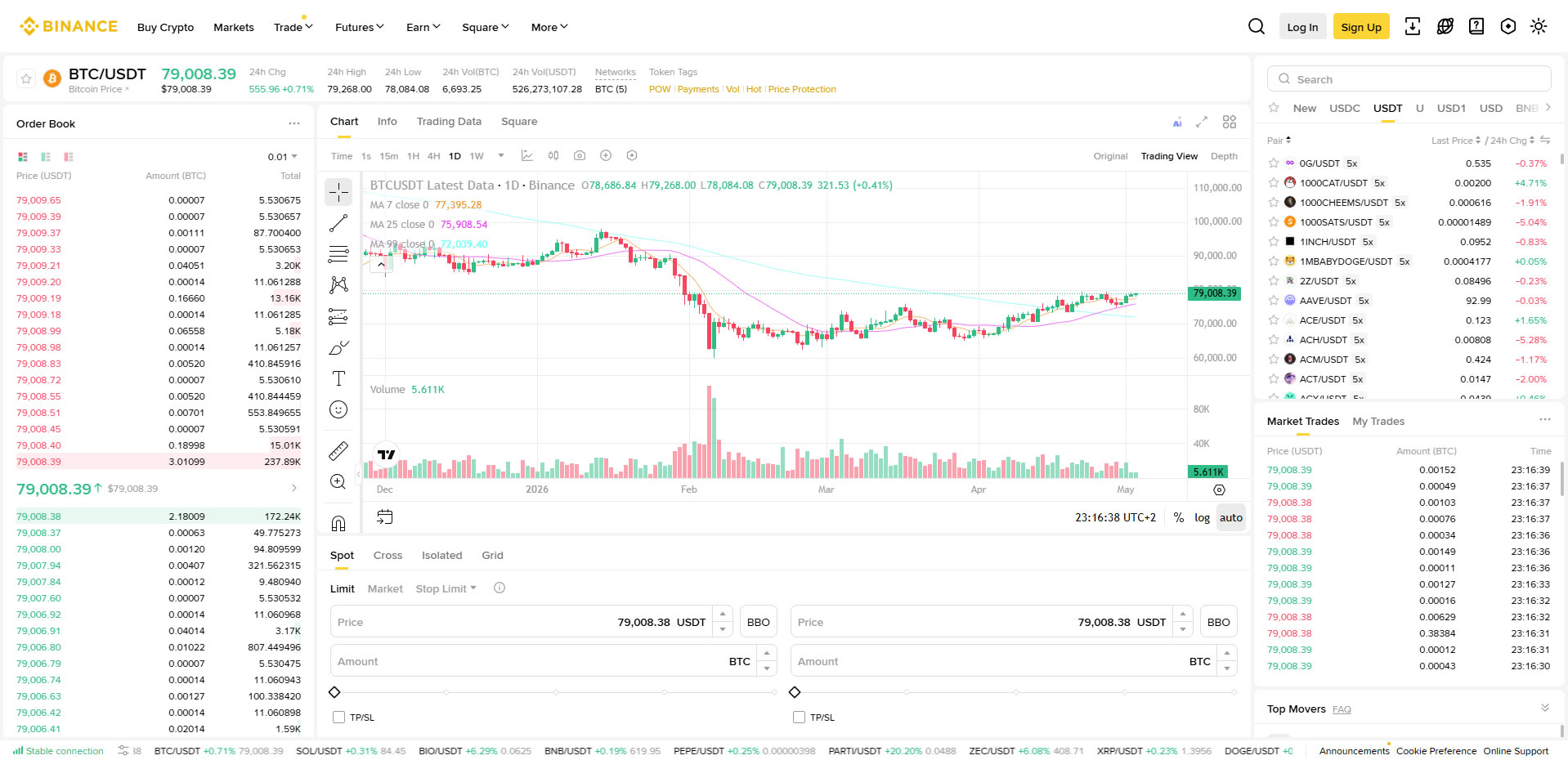
Supported order types include regular limit, market and TP/SL, and additional conditional orders like stop limit, stop market, trailing stop, OCO, TWAP, post-only and scaled orders.
Native charting system can be used, but the platform also fully integrates TradingView with a wide range of indicators. Additional options include a multi-chart or multi-symbols views for advanced traders, a heatmap panel, and an excellent trading data tab with information about open interest, long/short ratios, and other useful data.
If anything, Binance has too many options (for beginners), making it slightly overwhelming for new users. But in general, it has one of the most advanced trading interfaces in the industry.
Customer Support Channels
Customer support can easily be reached, and it is very quick to solve issues through any of the available channels:
- Live Chat: This is the main support channel. Users start with a chatbot, which filters common issues before passing them to a human agent. Response times vary. Simple issues get handled quickly, while complex cases can take longer.
- Ticket System: Users can submit detailed requests through a ticket system. This works better for account problems, verification issues, or disputes. It’s slower than chat, but usually more thorough.
- Help Center: Binance maintains a large self-service knowledge base. It covers guides, FAQs, and troubleshooting steps. For common questions, this is often the fastest way to get answers.
- Email Support: Direct email support exists but is not the primary method. Most requests get routed back into the ticket system anyway.
- Social Media: Binance stays active on platforms like X and Telegram. These channels are useful for updates and announcements, but not ideal for resolving account-specific issues.
- Phone Support: Phone support is generally not available. That’s a weak spot compared to some traditional financial platforms.
Supported Languages
Binance supports a wide range of languages, which helps explain its global reach. The interface, help center, and mobile apps are localized for users across different regions.
Currently supported languages (30):
The quality of translations is usually solid, though some smaller language versions can feel slightly off in technical sections.
6. Safety & Security
Company Information and Overview
Binance operates as a global crypto platform without a single clear headquarters. That structure helped it expand quickly, but it also created some friction with regulators in the past4. The company has shifted leadership and regional entities over time, especially after founder Changpeng Zhao stepped down as CEO in 2023 following legal pressure in the United States.
Despite that turbulence, Binance is today the largest exchange by volume and user base, and this scale brings both advantages and scrutiny. More users mean deeper liquidity, but also more attention from regulators worldwide.
Regulatory Compliance and Licenses
Binance’s regulatory status is complicated and constantly changing. It operates through multiple regional entities, each subject to local rules. Countries like the United States, the United Kingdom, and parts of Europe have tightened oversight, forcing Binance to adjust or limit certain features.
Binance’s global platform is currently regulated and licensed in Abu Dhabi and Dubai, France, Italy, Spain, Poland, Sweden, Kazakhstan, Bahrain, Australia, India, Indonesia, Japan, New Zealand, Thailand, Mexico, El Salvador, Argentina, Brazil, and South Africa. Additional regional Binance platforms/companies are licensed and support users from United States5, Turkey, Indonesia, and other countries.
In total, Binance has licenses and approvals in more than 20 countries, making it one of the most regulated exchanges in the world.
Available and Restricted Countries
Binance is available in many parts of the world, but not everywhere. It does not offer full services in heavily regulated markets like the United States, where a separate platform, Binance.US, operates with limited features. Other restricted or partially restricted regions include countries under sanctions or with strict financial laws.
You can quickly check if your country is supported below:
Binance is available in a total of 218 countries, and restricts users from 7 countries. Restricted countries include Canada, Cuba, Iran, Malaysia, Netherlands, North Korea, and United Kingdom.
Even within supported countries, some features may be disabled. For example, futures trading or certain earning products might not be accessible due to local compliance requirements. In most countries, the full set of features is available.
Platform and Funds Safety
Binance relies heavily on layered security infrastructure6 to protect user funds and platform activity. The majority of assets are stored in offline cold wallets, reducing exposure to online threats. Wallet systems use multisignature and threshold signature schemes, adding extra approval layers before transactions go through.
The platform runs continuous real-time monitoring across key account actions. User data is protected through encryption both at rest and during transmission. This includes sensitive information like KYC documents, which are stored securely and only accessible under strict controls. Binance also maintains internal security teams and infrastructure designed to prevent unauthorized access at both system and personnel levels.
To assist with vulnerability detection, Binance has an active bug bounty program7, through which hundreds of security issues have been fixed. Needless to say, Proof of Reserves reports8 are public, ensuring anyone can independently verify that all customer deposits are safely stored.
To cover worst-case scenarios, Binance operates the Secure Asset Fund for Users (SAFU)9, an emergency reserve created in 2018. The fund has been maintained at 15,000 BTC (around $1 billion) and is intended to compensate users in case of major security breaches.
User Account Security
On the user side, Binance offers a strong set of security tools, though it’s up to individuals to use them properly:
- Two-factor authentication is standard and can be set up with apps, phone, email, or hardware keys.
- Withdrawal whitelist features let users restrict transfers to approved addresses only, which helps prevent unauthorized access.
- Anti-phishing codes add another layer by allowing users to verify official Binance emails.
- There are also additional protections like login alerts, device management, session monitoring, and account freeze function.
- Advanced options include passkeys and additional verification steps for sensitive actions.
These features make accounts much harder to compromise, but only if users actually enable them. In short, Binance provides solid security infrastructure. The weak link, as usual, tends to be user behavior rather than the platform itself.
Is Binance a Safe Exchange?
Binance checks all of the technical boxes when it comes to security. Cold storage, real-time monitoring, encrypted data handling, and layered account protections are all in place. All customer deposits are accounted for, and the addition of the SAFU fund gives users a fallback in case something goes seriously wrong, which not every exchange offers.
It’s hard to imagine being the world’s most popular crypto exchange without regulatory and legal issues. But despite some regulatory warnings and fines in its early years, Binance is nowadays fully compliant with laws where it operates, and has licenses and approvals in dozens of countries. It frequently works with local law enforcements, runs educational initiatives, cybercrime workshops, and collaborates with security researchers.
There are zero doubts that Binance is a fully legitimate exchange, and always aiming for full legal compliance.
7. Conclusion
Binance sits as an undisputed #1 exchange in the world. It’s both the industry leader and a constant work in progress. Few platforms match its sheer range of features, trading volume, and global reach. At the same time, that size brings complexity, regulatory pressure, and the occasional rough edge.
For active traders, Binance is hard to beat. The combination of deep liquidity, low fees, and access to spot, margin, and derivatives markets makes it a go-to platform. Tools like advanced order types, trading bots, and subaccounts add real depth. Beginners can still get started, but they need a bit of patience to get comfortable with the interface.
Beyond trading, Binance tries to keep users inside its ecosystem. Features like staking, loans, and crypto payments turn it into more than just an exchange. For some, that’s convenient. For others, it can feel like too much packed into one place.
Security is solid on a technical level. Cold storage, reserve funds, and account protection tools do their job. The company’s regulatory history adds a layer of controversy, but it’s all part of its journey to become the world’s #1 crypto exchange.
Who is Binance Best For (and Not For)
- Active traders who rely on low fees and deep liquidity
- Experienced users who want access to spot, margin, and derivatives markets
- Traders running multiple strategies using bots, subaccounts, and advanced orders
- Users comfortable with a feature-rich, complex platform
- People looking for an all-in-one crypto ecosystem with staking, loans, and trading
- Beginners who want a simple, minimal interface from day one
- Passive investors looking for a clean, set-it-and-forget-it experience
Binance works best for users who want options and don’t mind a learning curve. It suits active traders, especially those who care about low fees and deep liquidity. Anyone trading frequently, using leverage, or running multiple strategies will find the platform hard to replace.
More experienced users tend to get the most value. The mix of spot, margin, and derivatives markets gives them room to execute different strategies in one place. Tools like bots, subaccounts, and advanced order types make a real difference once someone knows what they’re doing.
Passive investors can still use Binance, but it’s a mixed fit. Features like recurring purchases and staking help simplify things, yet the interface can feel like overkill. It works, but it doesn’t always feel designed for a set-it-and-forget-it approach.
Beginners can start here, especially considering the variety of fiat deposit options and features like convert and demo trading. Though, there might be a bit of friction due to the learning curve. The basic interface helps, and Binance Academy fills in knowledge gaps, but the platform throws a lot at new users. Simpler exchanges often feel easier at the start.
Final Verdict
Binance rewards users who engage with it. Those who just want a simple place to buy and hold crypto might find it more complicated than necessary. On the upside, most users who start on Binance will never need to use another platform.
In the end, Binance works best for users who want everything in one place and don’t mind a bit of complexity. For casual users or those in tightly regulated regions, simpler alternatives might feel easier. Binance doesn’t try to be simple. It tries to be everything, and for better or worse, it gets pretty close.
Sources and references:
- bStocks tokenized securities: https://www.binance.com/en/support/announcement/detail/2c0c92ed15ac42d1b14bb1eac00d22bb ↩︎
- Fees and transactions overview: https://www.binance.com/en/fee/trading ↩︎
- Binance Desktop: https://www.binance.com/en/download ↩︎
- Binance legal status history: https://en.wikipedia.org/wiki/Binance#Legal_status ↩︎
- Binance.US supported states: https://support.binance.us/en/articles/9842798-list-of-supported-and-unsupported-states-and-regions ↩︎
- User protection and security: https://www.binance.com/en/events/user-protection ↩︎
- Binance bug bounty: https://bugcrowd.com/engagements/binance ↩︎
- Proof of Reserves: https://www.binance.com/en/proof-of-reserves ↩︎
- Secure Asset Fund for Users (SAFU): https://www.binance.com/en/academy/glossary/secure-asset-fund-for-users ↩︎

All reviews submitted are moderated. Negative opinions are fine. Spam, competitor promotion, false claims, FUD or unsubstantited criticism is not approved.