











1. Exchange Overview
CoinEx is built around simplicity, accessibility, and has a surprisingly broad feature set. Launched in 2017 and backed by the ViaBTC mining pool ecosystem, the platform focuses on providing a stable trading environment with minimal friction, especially for users who prefer to avoid heavy verification requirements. It appeals to a wide range of traders, from casual users testing the waters to more experienced traders who value advanced tools and low entry barriers.
One of CoinEx’s main selling points is its optional KYC structure, which allows users to start trading quickly without immediate identity verification. This approach makes the platform especially attractive in regions where access to major regulated exchanges is limited. At the same time, CoinEx still offers higher withdrawal limits and additional security benefits for users who choose to verify, giving a balance between privacy and functionality.
The exchange also has a diverse ecosystem that goes beyond simple spot trading. Users get access to futures markets, margin trading, staking products, and even Web3 wallet functionality. While it may not match the sheer liquidity of top-tier exchanges, CoinEx compensates with a wide selection of altcoins and emerging tokens, which often appear on the platform earlier than elsewhere.
Another strong point is its clean and approachable interface, which avoids overwhelming users with excessive complexity. Despite this simplicity, advanced tools like copy trading, automated strategies, and pre-market trading are still available under the hood. This balance between ease of use and depth of features is where CoinEx quietly excels.
- Optional KYC with $10,000 daily withdrawal limit
- Wide range of altcoins and early listings
- Strong ecosystem with earn products and trading tools
- Competitive futures fees and accessible VIP tiers
- Integrated Web3 wallet and onchain functionality
- Insurance fund backed by trading fee allocation
- Limited native fiat deposit options
- Spot trading fees higher than some competitors
- P2P market lacks strong liquidity in smaller regions
- No options trading for advanced derivatives users
- Regulatory coverage is minimal
2. Fiat Payments and Fees
Direct Payments
CoinEx offers plenty of variety with global fiat payment methods, but currency support has more noticeable limitations. The only direct local fiat integration available is PIX in Brazil, meaning users from most regions cannot deposit fiat directly through the exchange itself. As a result, most users must rely on third-party services to convert fiat into crypto before trading.
That said, CoinEx’s Quick Buy integrates with Paybis, which still provides a seamless on-ramp experience compared to many competitors. Through Paybis, users can purchase crypto using SEPA transfers, Skrill, Neteller, Revolut, PayPal, and bank cards, although this is currently limited to EUR transactions. Paybis also supports withdrawals, allowing users to cash out via SEPA, cards, Skrill, and Neteller, which partially fills the gap left by the lack of native fiat withdrawals.
| Payment method | Supported currencies | Deposit fee | Withdrawal fee |
|---|---|---|---|
| Visa and Mastercard | Any supported | 3% | Supported, unknown fees |
| SEPA bank transfer | EUR | 1% | Supported, unknown fees |
| PIX | BRL | No fees | Not available |
| Revolut | Any supported | 2.6% | Not available |
| PayPal | Any supported | Supported, unknown fees | Not available |
| Skrill | Any supported | 5% | Supported, unknown fees |
| Neteller | Any supported | 5% | Supported, unknown fees |
Fiat deposits and withdrawals always require completed identity verification. If you are in a supported country, it only takes 5 minutes.
Despite this integration, CoinEx still falls a little bit short of being a fully self-contained fiat-to-crypto platform. Users looking for a seamless bank-to-exchange experience may find this setup slightly inconvenient, especially beginners who prefer everything in one place.
3rd Party Gateways
CoinEx supports a wide range of third-party fiat gateways, which help fill any and all gaps in direct payment options. Integrated providers include Volet, Simplex, MoonPay, Banxa, Mercuryo, and Guardarian, giving users multiple ways to purchase crypto depending on their region and preferred payment method. This variety improves accessibility, even if fees can vary significantly between providers.
 Visa/Mastercard
 SEPA Transfers (EU/EUR)
 SWIFT Transfers (International)
 ACH Transfers (US/USD)
 Google Pay
 Apple Pay
 PayPal
 Other Bank Transfers
 Revolut Pay
These gateways typically support common payment methods such as debit and credit cards, bank transfers, and regional solutions. However, users should be aware that fees through these services are generally higher than direct exchange deposits, often including both processing fees and spreads. Still, having multiple providers increases the chances of finding a suitable option in most countries.
P2P Market
CoinEx also offers a peer-to-peer marketplace, although it is not among the most active in the industry. Most of the supported 60+ fiat currencies have at least one active trader, often using popular local payment methods. This makes it usable, but not always competitive in terms of pricing or liquidity.
In larger markets such as India, Vietnam, Indonesia, or Nigeria, the P2P section is more active, with multiple sellers and better pricing competition. Users in these regions will likely find the P2P option more practical, while those in smaller markets may experience limited offers.
Direct fiat withdrawals can be done in BRL (via PIX), or through Paybis in Euros (SEPA, Skrill, Neteller, and cards). Multiple gateways can also be used for withdrawals, covering dozens of global and local payment methods.
3. Crypto Markets and Fees
Crypto Trading Markets
CoinEx offers a broad selection of markets that cater to different trading styles, although it does not cover every advanced product type found on larger exchanges.
- Spot Trading: The core of the platform, with 1,000+ crypto pairs including many smaller altcoins. It is straightforward and suitable for both beginners and experienced users who want access to emerging tokens.
- Margin Trading: Allows users to borrow funds and amplify positions, although the offering is more limited compared to top-tier exchanges. It is still sufficient for basic leveraged strategies.
- Futures Trading: CoinEx provides perpetual futures contracts with leverage, offering a more advanced trading environment. The interface remains relatively simple, which helps reduce the learning curve for new derivatives traders.
- Onchain Markets: Supports trading and interaction across networks like Ethereum, Solana, and Binance Smart Chain. This adds a layer of Web3 functionality, bridging centralized trading with decentralized ecosystems.
- TradFi Markets: CoinEx includes a selection of tokenized assets available on spot markets, along with a limited range of mainstream stock indices and commodities on derivatives. While not extensive, it gives users exposure to most popular traditional assets.
Notably, CoinEx does not offer options trading or delivery futures, which may be a drawback for advanced derivatives traders.
Trading Fees
CoinEx uses a relatively simple fee structure1, though its spot fees are slightly higher than the industry average. Spot trading is charged at 0.2% for both maker and taker orders, which places it above some competitors that range between 0.1% and 0.2%.
Futures trading fees are more competitive, with 0.03% maker (minimum) and 0.05% taker (maximum per trade) fees. The maker fee is slightly above average, while the taker fee is slightly below, making it fairly balanced overall. This structure can be attractive for traders who rely more on market rather than limit orders.
The platform’s native token, CET2, provides a 20% discount on spot trading fees when used for payments. Users simply need to buy and hold any amount of CET and use it to pay for fees, and the fee rebates are automatically applied. Furthermore, holding just around ~$100 worth of CET upgrades you to VIP level 1. Paired with CET deduction, spot fees drop to 0.144% already.
Speaking of VIPs, CoinEx offers a VIP tier system3 based on CET holdings, total account balances, or trading volume. The requirements are relatively low compared to most exchanges, with VIP 1 accessible at just $10,000 in total assets, or $20k spot or $200k futures trading volume thresholds, making fee reductions easily achievable for active traders.
Signup Bonuses
A $100 signup bonus is available to all new users in the Reward Center4. The $100 might not sound like much since many competitors claim more, but there’s no fluff or crazy requirements on CoinEx. Buying crypto with fiat gives you $40, trading spot over $50 volume gives you another $30, and completing futures volume over $300 gives you another $30. The rewards are given in CET and in the form of fee rebates, essentially means you can save $100 in additional fees.
In addition, using referral code “zxsn9” during signup acts as a coupon, applying a permanent 5% trading fee reduction to newly created accounts. This is an easy way to save on fees without any downsides or costs whatsoever.

Other Trading Features
CoinEx includes several additional tools that enhance its trading ecosystem without overcomplicating the experience. Demo trading is available for users who want to practice strategies without risking real funds, which is especially useful for beginners. Copytrading isn’t available.
The platform also supports recurring purchases and scheduled buys, making it easier to build positions over time through dollar-cost averaging.
Advanced users can take advantage of subaccounts, and basic trading bots (DCA, and spot and futures grid bots). Additional features like pre-market trading give users early access to certain tokens before they are widely listed, adding another layer of opportunity for active traders.
4. Other Features and Services
The platform goes beyond basic trading by offering a solid range of additional services that cover both passive income and utility-focused features. While it may not compete with the largest ecosystems, it still provides enough variety to keep most users engaged within the platform. These tools are integrated cleanly, which makes them easy to access without cluttering the interface.
- Loans: CoinEx allows users to borrow crypto by using their existing assets as collateral. The process is straightforward, with flexible terms and relatively quick approvals, making it suitable for short-term liquidity needs or leveraged strategies.
- Staking and Earn: The Earn section includes flexible and fixed savings, on-chain staking, dual investment products, and AMM-based earning opportunities. Users can generate passive income on idle assets, although returns vary depending on the product and market conditions.
- Gift Cards: Users can purchase crypto gift cards directly through the platform, which can be redeemed or shared. This adds a practical use case for crypto beyond trading, especially for gifting or transferring value in a simple format.
- C-BOX (Crypto Gifting): CoinEx includes a unique feature called C-BOX, which allows users to send crypto gifts to other users in a more interactive way. It works similarly to digital envelopes, adding a social element to crypto transfers.
- Optional KYC: Verification is not mandatory, which is one of CoinEx’s defining features. Unverified users can withdraw up to $10,000 per day, while verified accounts can access limits up to $1 million, along with additional security assurances.
- Web3 Wallet: CoinEx offers an integrated Web3 wallet that supports interaction with decentralized applications. This feature helps bridge centralized trading with DeFi, allowing users to manage assets across different ecosystems from one place.
5. User Experience
CoinEx keeps its user experience simple and functional, which works in its favor. The platform avoids unnecessary clutter, while still offering enough customization to satisfy more advanced users. Both the web platform and mobile app are consistent in design, which makes switching between devices feel natural.
Overall User Experience
The interface is clean and easy to understand, even for users who are new to crypto trading. Navigation is intuitive, with clearly labeled sections and minimal friction when moving between features. One notable advantage is the availability of a full dark theme across both the trading interface and account dashboard, which improves usability during long sessions.
CoinEx also provides guides and tutorials within its help center, helping users understand core features without leaving the platform. While not overly detailed, these resources are enough to get most users started without confusion.
Trading User Interface
The trading interface strikes a balance between simplicity and functionality. Charts are powered by TradingView, giving users access to advanced technical analysis tools, while order placement remains straightforward. Multiple order types are supported, including limit, market, and stop-limit orders.
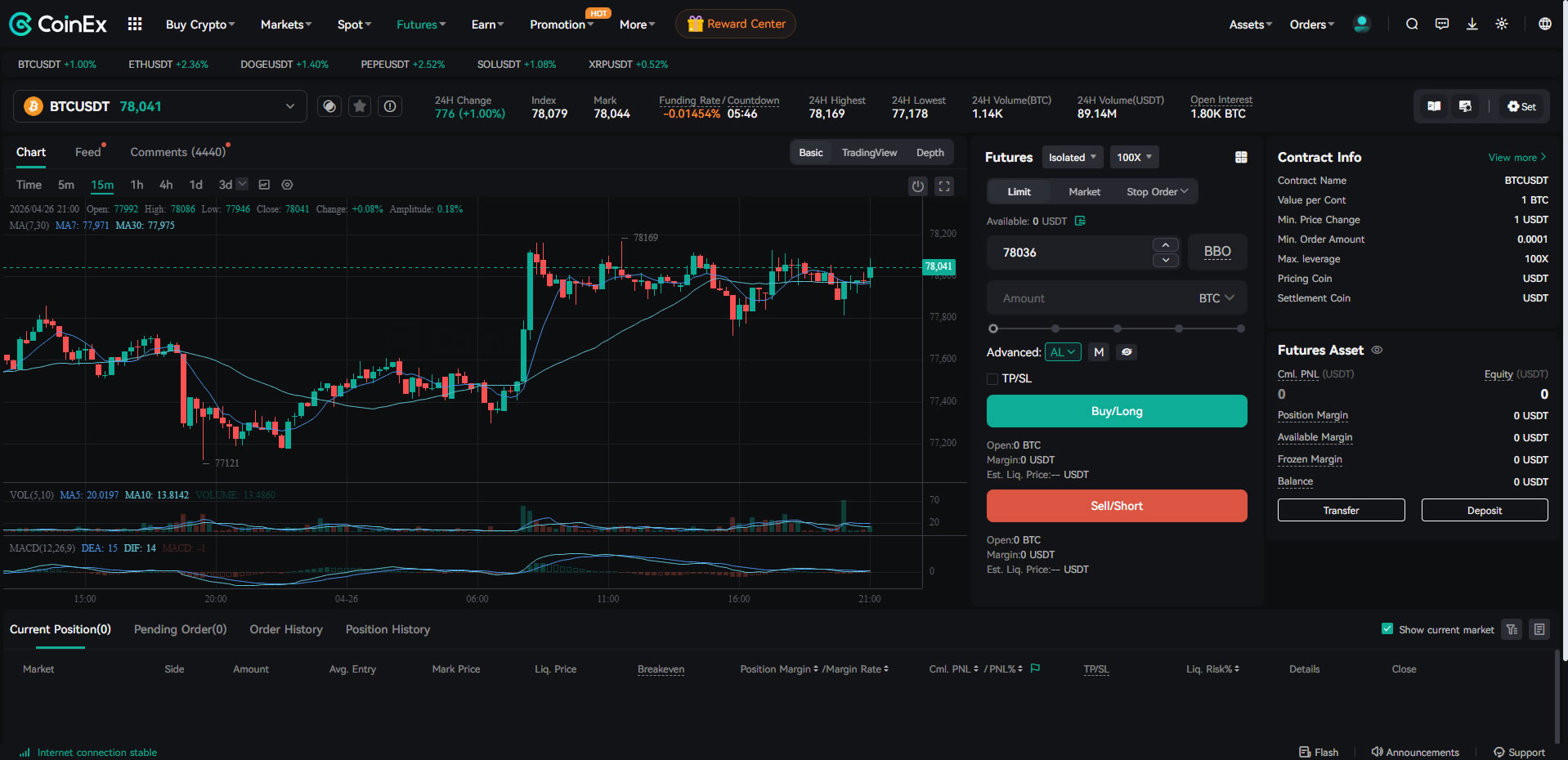
Customization options on Futures are excellent, allowing users to fully adjust layouts, indicators, and chart settings to match their preferences. The interface is responsive and performs well even during periods of higher market activity, which is critical for active traders. As a downside, spot UI doesn’t have many customization options, so spot-heavy traders may feel a bit neglected.
Customer Support Channels
CoinEx offers a range of customer support options, although it doesn’t include phone support. Users can reach out through email and a ticketing system, which is the primary method for resolving issues. A live chat feature is also available, providing quicker responses for general inquiries.
In addition, CoinEx maintains an active presence on social media platforms, where users can find updates and community support. The help center is well-organized, covering common issues and frequently asked questions in a clear format.
Supported Languages
CoinEx supports a wide range of languages, making it accessible to a global audience. This includes major languages across Asia, Europe, and other regions, which aligns with its international user base.
Currently supported languages (18):
6. Safety & Security
Security is an area where CoinEx performs exceptionally well, especially considering its optional KYC model. The platform combines standard security practices with additional protective measures, although it does not position itself as a heavily regulated exchange.
Company Info and Overview
CoinEx was founded in 2017 and operates as part of the ViaBTC ecosystem, one of the larger Bitcoin mining pools globally. This connection gives the exchange a strong technical foundation, especially in areas like infrastructure, blockchain operations, and system reliability. It’s not merely a standalone exchange, but part of a broader crypto network with experience in handling large-scale operations.
From the beginning, CoinEx has focused on building a global platform with fewer restrictions than heavily regulated competitors. The trade-off is a lighter regulatory footprint, but also greater accessibility for users worldwide. Over the years, it has continued to expand its services while maintaining a relatively clean track record in terms of major incidents. That stability plays an important role in building trust, especially for users who prioritize reliability over strict compliance.
CoinEx also invests in its internal security structure, including a dedicated security team and oversight committee. These teams focus on monitoring threats, improving system defenses, and ensuring that the platform can respond quickly to potential risks. While it may not have the same regulatory backing as top-tier exchanges, it compensates with a strong internal focus on operational security.
Regulatory Compliance and Licenses
CoinEx holds a basic Money Services Business registration in the United States, but keep in mind it does not support KYC from US customers. This registration provides a minimal level of compliance, but does not equate to full regulatory approval.
It’s worth noting that obtaining licenses is significantly more difficult for exchanges that allow no-KYC trading. Given this privacy focused model, the limited regulatory footprint is not unusual and aligns with similar platforms in the industry.
Available and Restricted Countries
CoinEx is available in many regions worldwide, but certain jurisdictions are restricted5 due to strict regulatory requirements.
CoinEx is available in nearly 200 countries, and restricts users from several countries6, plus entire EEA (European Economic Area)7. Restricted countries include Canada, China, Hong Kong, United Kingdom, Switzerland, Kazakhstan, and United States. Countries under international sanctions including Iran, North Korea and Cuba are also restricted.
Platform and Funds Safety
CoinEx uses a multi-layered security system8 to protect user funds and platform operations. Most assets are stored in cold wallets with offline private keys, while hot wallets are used only for daily transactions. The platform relies on proprietary cold storage, multi-signature protocols, and dedicated hardware authentication to reduce risks.
It also implements MPC-based dual-signature technology, multi-location backups, and strict authorization controls. Real-time monitoring systems track deposits, withdrawals, and abnormal activity, supported by automated alerts to quickly detect potential threats. Additional protections include whitelisting mechanisms and independent infrastructure design.
CoinEx maintains a 100% proof of reserves9 policy, ensuring all user funds are fully backed. It also operates a Shield Fund, which receives 10% of trading fees and is valued at over $30 million, designed to cover losses during extreme events. Security is further strengthened through regular audits, a bug bounty program10, and a partnership with cybersecurity firm SlowMist, which supports threat detection and risk monitoring.
Overall, the platform has some of the most comprehensive security policies out of any exchange, and it’s definitely one of the safest no-KYC exchanges to use.
User Account Security
On the user side, CoinEx provides a comprehensive set of account-level security tools that users can customize based on their needs. Two-factor authentication is supported through multiple methods, including TOTP authenticators, mobile verification, and hardware devices like passkeys or security keys.
Additional safeguards include withdrawal passwords and separate trading passwords, adding extra layers of protection for sensitive actions. Features like anti-phishing codes and official verification channels help users verify official communication, reducing the risk of scams or impersonation attempts.
Advanced controls such as withdrawal whitelists, multi-approval mechanisms, emergency contacts and login IP restrictions give users more control over account access. These tools are particularly useful for high-value accounts or shared account management, helping reduce the risk of unauthorized activity. Logouts can optionally be forced whenever user IP address changes, and auto-logouts can be turned on after a period of inactivity. In the case of emergency, users can quickly freeze their accounts to further prevent any potential damage.
In summary, CoinEx has some of the most detailed and advanced user account security options across all exchanges, more than sufficient to prevent a vast majority of attack vectors.
Is CoinEx Safe or Unsafe?
CoinEx can be considered reasonably safe, especially when compared to other exchanges that offer optional KYC and global access. It combines solid technical protections like cold storage, MPC-based security, and real-time monitoring with additional safeguards such as proof of reserves and an active insurance fund. These measures show a clear focus on protecting user assets, even without heavy regulatory oversight.
However, it’s not among the most strictly regulated exchanges, which may be a concern for users who prioritize legal protections above all else. The lack of top-tier licenses means users rely more on the platform’s internal security practices rather than external enforcement. For many users, this is an acceptable trade-off, but it’s still worth considering.
Overall, CoinEx sits in the middle ground. It’s not the most regulated platform, but it is far from unsafe. For users who value accessibility, privacy, and a detailed set of security features, it offers a dependable environment, provided basic account protections like 2FA and withdrawal controls are properly used.
7. Conclusion
CoinEx is a diverse, globally accessible exchange that prioritizes ease of use and low entry barriers. It doesn’t try to compete directly with heavily regulated giants, but instead focuses on providing a feature-rich environment for users who value accessibility and variety. The result is a platform that feels approachable, yet capable enough for very serious trading activity.
Who It’s Best For (and Not For)
CoinEx works well for a specific type of user, but it’s not a perfect fit for everyone.
- Beginners: Good starting point due to simple interface and demo trading, though fiat access is limited.
- Active traders: Solid option thanks to futures markets, trading tools, and relatively low VIP requirements.
- Passive investors: Strong fit due to staking, savings, and automated investment features.
- Privacy-focused users: Very appealing because of optional KYC and reasonable withdrawal limits.
- Altcoin traders: Great choice for users looking for a wide range of smaller or early-listed tokens.
- Fiat-focused users: Not ideal, since deposits and withdrawals rely heavily on third parties.
- Fee-sensitive spot traders: Higher spot fees than many competitors can add up over time.
- Regulation-focused users: Limited licensing and no availability in some major jurisdictions.
Final Verdict
CoinEx does a lot right by keeping things simple without stripping away useful features. It offers a smooth onboarding experience, especially for users who want to start trading quickly without dealing with heavy verification. At the same time, it quietly includes enough advanced tools to support more experienced traders.
The platform’s biggest strength lies in its balance. It manages to combine accessibility, a wide asset selection, and practical earning features without overwhelming users. The addition of copy trading, bots, and Web3 functionality shows that CoinEx is not just a basic exchange, even if it presents itself that way on the surface.
That said, it’s not without flaws. The somewhat limited direct fiat withdrawals and built-in payment methods can make it less convenient, particularly for beginners who expect a complete all-in-one solution. No matter how seamlessly integrated, some fiat users may need to rely on external services, which can add extra steps and sometimes higher costs.
Even with those drawbacks, CoinEx remains a strong option for users who prioritize unrestricted access to crypto trading markets. It may not be the most polished or regulated exchange, but it has sufficient volume and liquidity, plenty of altcoins, and all the trading features you might need.
Sources and references:

All reviews submitted are moderated. Negative opinions are fine. Spam, competitor promotion, false claims, FUD or unsubstantited criticism is not approved.