











1. Exchange Overview
Bitunix is a relatively newer crypto exchange that focuses on derivatives trading while still offering a high volume and cheap spot market and a growing set of features. The platform leans heavily into usability and low fees, which makes it appealing to both newer traders and more active users who want to keep costs down. It avoids overcomplicating things, yet still packs in enough tools to satisfy more advanced strategies.
One of its strongest selling points is accessibility. Bitunix allows optional KYC, which means users can sign up quickly and start trading without going through lengthy verification. At the same time, it still offers fairly high withdrawal limits without verification, which is becoming increasingly rare across the industry. This balance between privacy and functionality is a major draw for many traders.
The exchange also puts a lot of emphasis on derivatives trading, offering futures markets with competitive fees and leverage options. While it does not try to compete with the largest exchanges in terms of sheer asset count, it provides a focused and reliable selection of trading pairs. This makes it easier to navigate, especially for users who prefer a cleaner trading environment over overwhelming choice.
Another notable strength is its feature set beyond basic trading. Bitunix includes copy trading, automated bots, and advanced chart alert systems that rival premium tools on other platforms. Combined with a modern interface and consistent platform updates, it’s a well-rounded exchange that prioritizes both functionality and user experience.
- Very low spot trading fees, especially for makers
- Optional KYC with high withdrawal limits
- Strong futures trading interface with up to 200x leverage
- Built-in advanced chart alerts with multi-channel notifications
- Wide fiat access through multiple third-party gateways
- Copy trading and bot features included
- Proof of reserves and no history of major security breaches
- No margin trading or demo account
- Limited P2P marketplace liquidity
- Smaller selection of TradFi assets
- No native token for fee discounts
- Lacks loans and broader financial services
- Spot trading interface has limited customization
2. Payment Methods and Fees
Direct Payments
Bitunix supports direct fiat deposits primarily through bank cards and SEPA transfers, making it accessible for users in many regions. These methods are available globally, but only for deposits, meaning users cannot withdraw fiat directly using these same rails. The process is straightforward and works well for quickly funding an account with minimal friction.
| Payment method | Supported currencies | Deposit fee | Withdrawal fee |
|---|---|---|---|
| Visa and Mastercard | Any supported | 3.5% | Not available |
| SEPA bank transfer | EUR | No fee | Not available |
| PIX | BRL | No fee | Not available |
In addition to standard global options, Bitunix also supports localized payment systems in select regions. For example, users in Brazil can use PIX, while those in Indonesia can access QRIS payments. These integrations make the platform more usable in underserved markets where traditional banking infrastructure may be less efficient.
Fees for direct payments vary depending on the method and region, but they are generally competitive with industry norms. While not the absolute cheapest option available, the convenience and speed often justify the cost, especially for users making smaller or time-sensitive deposits.
3rd Party Gateways
As an alternative means of buying crypto, Bitunix integrates several third-party fiat gateways, such as Volet, MoonPay, Alchemy Pay, OSLPay and Guardarian. These services significantly expand the platform’s fiat capabilities, allowing both deposits and withdrawals in many cases. This is especially useful given that direct withdrawals are not supported through native methods.
Through these gateways, users gain access to over 50 fiat currencies and a wide range of local payment options. This includes mobile money services across Africa, PayPal, Revolut, and various QR-based payment systems. As a result, Bitunix becomes far more accessible globally than its core banking integrations might suggest.
 Visa/Mastercard
 SEPA Transfers (EU/EUR)
 SWIFT Transfers (International)
 Google Pay
 Apple Pay
 PayPal
 Skrill
 Neteller
 Other Bank Transfers
 Revolut Pay
The tradeoff comes in the form of fees, which are typically higher than direct bank transfers. Each gateway sets its own pricing structure, so costs can vary widely depending on location and method. Still, for users who prioritize flexibility and availability, these gateways provide a valuable bridge between crypto and fiat.
P2P Market
Bitunix also offers a peer-to-peer marketplace, though it remains relatively underdeveloped compared to larger exchanges. The number of active merchants is limited, which can make it harder to find competitive offers or high liquidity for certain currencies.
That said, the P2P market can still be useful in specific regions where traditional fiat on-ramps are restricted or unavailable. In these cases, even a smaller marketplace can provide an important alternative for entering or exiting crypto positions.
For most users, the P2P section will likely serve as a backup option rather than a primary method. However, its presence adds another payment layer, especially for customers in less supported markets.
3. Trading Markets and Fees
Crypto Trading Markets
Bitunix offers three main types of trading markets:
- Spot: The spot market allows users to buy and sell cryptocurrencies directly with relatively low fees. It covers a decent selection of major and mid-cap assets, making it suitable for most standard trading needs. However, it does not offer margin trading, which may be a limitation for more advanced users.
- Futures: This is where Bitunix really focuses its efforts. The futures market supports perpetual contracts with leverage of up to 125x, catering to active traders who want to amplify their positions. The interface is way more advanced than spot and includes additional customization options, making it the platform’s strongest offering.
- TradFi: Bitunix’s Futures market includes several dozen mainstream traditional financial instruments such as stocks, indices, and commodities. On Spot, only gold is tradeable as an asset, with no other tokenized stocks or instruments. However, Bitunix’s CFD section includes a much larger selection of gold, oil, stocks, forex, indices and other assets.
It’s worth noting that Bitunix doesn’t support margin, leveraged tokens, nor on-chain trading or decentralized features, keeping everything within a centralized exchange structure.
Trading Fees
Bitunix is highly competitive when it comes to trading fees, particularly on the spot market. Spot trading fees are set at 0.08% for makers and 0.1% for takers. The taker fee is among the lowest in the industry, while the maker fee is even lower than what most major exchanges offer.
For futures trading, fees are 0.02% for makers and 0.06% for takers. These rates fall in line with industry averages, making them fair but not particularly standout. Still, combined with the platform’s usability, they remain attractive for frequent traders.
The platform doesn’t have a native token for fee discounts, which simplifies the structure but removes one potential way to save. Instead, users can access reduced fees through VIP levels1, which are based on trading volume or account balance. The entry threshold is relatively accessible, with balances over $500 being the easiest way to qualify for the first tier, which already reduces certain fees by 15-20%.
Referral programs also provide additional fee discounts, which can further reduce costs for active users. You can use referral code “flaDfy” during account registration to apply a permanent 5% trading fee discount to your account. Overall, Bitunix is a low-cost exchange even without relying on complex token-based systems.

Other Trading Features
Bitunix includes a range of additional trading tools designed to enhance both active and passive strategies:
- Copy trading: Users can automatically replicate the trades of more experienced traders. This is especially useful for beginners or those who prefer a more hands-off approach.
- Recurring purchases: Scheduled buying allows users to automate dollar-cost averaging strategies over time, helping reduce the impact of market volatility.
- Subaccounts: Traders can create multiple subaccounts to separate strategies, manage risk, or organize funds more effectively.
- Trading bots: The platform supports spot DCA bots and futures grid bots. While not the most extensive selection, these tools cover the most common automated strategies.
Bitunix does not offer demo trading or margin trading, which may limit experimentation for some users. However, it compensates with a powerful trading interface that includes support for up to 16 charts simultaneously. It also has a multi-trade mode which allows users to open multiple positions in the same direction on a single pair, which is particularly useful for trading multiple timeframes and scalping.
Other Features and Services
Bitunix goes beyond basic trading by offering a set of additional features that cater to different types of users, from passive investors to more advanced traders. While it does not aim to be an all-in-one financial platform, it includes enough tools to cover most common use cases. The focus stays on practicality rather than overwhelming users with rarely used features.
- Staking: Bitunix provides staking options that allow users to earn passive income on supported cryptocurrencies. These products are relatively simple to use, making them accessible even to beginners. While the selection is not as extensive as on larger exchanges, it covers enough assets to be useful for long-term holders.
- Optional KYC: One of the platform’s biggest upsides is its optional verification system. Users can withdraw up to $500,000 per day without completing KYC, which is significantly higher than most exchanges. This makes Bitunix especially attractive for privacy-conscious users who still want access to high limits.
- Signup Bonuses: Bitunix offers various promotional incentives for new users, including up to $300 USDT in futures bonuses2. Additional deposit-based rewards can push total bonuses to $10,000 USDT, depending on how much is deposited and traded. These bonuses can be used as trading margin, or to offset losses or trading fees. They are structured to encourage platform engagement rather than acting as simple giveaways.
- Chart Indicator Alerts: One of the more unique features is the advanced alert system built directly into the trading interface. Users can set custom alerts for indicators like MACD, RSI, and Bollinger Bands, and receive notifications through web, mobile, Telegram, Discord, or email. This effectively replaces the need for paid charting tools like TradingView, making it a surprisingly powerful addition for active traders.
- Bitunix Card: Bitunix Card3 is a virtual VISA card available in most territories, and compatible with payment services like Google Pay, Apple Pay, WeChat Pay, Alipay, PayPal, Samsung Pay, or others. Only costs are 0.5% (USD transactions) or 1.5% (non-USD transactions), with no signup, top-up, annual, monthly, or other fees or costs. Cashback up to 8% can offset payment fees, making this one of the most cost-efficient ways to spend crypto directly.
Bitunix does not currently offer crypto-backed loans or borrowing services, which may limit its appeal for users seeking leverage outside of futures. The platform stays focused on trading and core investment features rather than branching into lifestyle finance tools.
4. User Experience
Bitunix delivers a clean and modern user experience that balances simplicity with functionality. The interface is intuitive enough for beginners, yet flexible enough for more advanced traders who want customization options. Both the web platform and mobile app are well-optimized, with consistent design and performance across devices.
Overall User Experience
The overall design of Bitunix is straightforward and easy to get used to, even for first-time users. Navigation is logical, with clearly separated sections for trading, assets, and account management. The platform avoids clutter, which helps reduce the learning curve.
Customization plays a key role in improving usability. Users can adjust layouts, charts, and trading panels to suit their preferences, although the spot interface has fewer options compared to derivatives. The platform also supports a full dark theme across both trading and wallet interfaces, which is a welcome feature for users who spend long hours on charts.
The website also provides guides and tutorials that help users understand platform features and trading basics. While not overly extensive, these resources are sufficient for onboarding new users and explaining key tools without overwhelming them.
Trading User Interface
The trading interface on Bitunix is functional and responsive, with a clear focus on derivatives trading. The spot interface is relatively simple and offers limited customization, which may feel restrictive for advanced users. However, it works well for straightforward buying and selling.
In contrast, the futures interface is much more advanced and customizable. Users can customize chart layouts, indicators, and trading panels to a much greater extent. Even a vertical layout is available, something that very few exchanges bother with. The platform supports leverage of up to 200x, along with multiple order types (limit, market, trigger, trailing stop, scaled, fixed risk), making it suitable for more complex strategies.
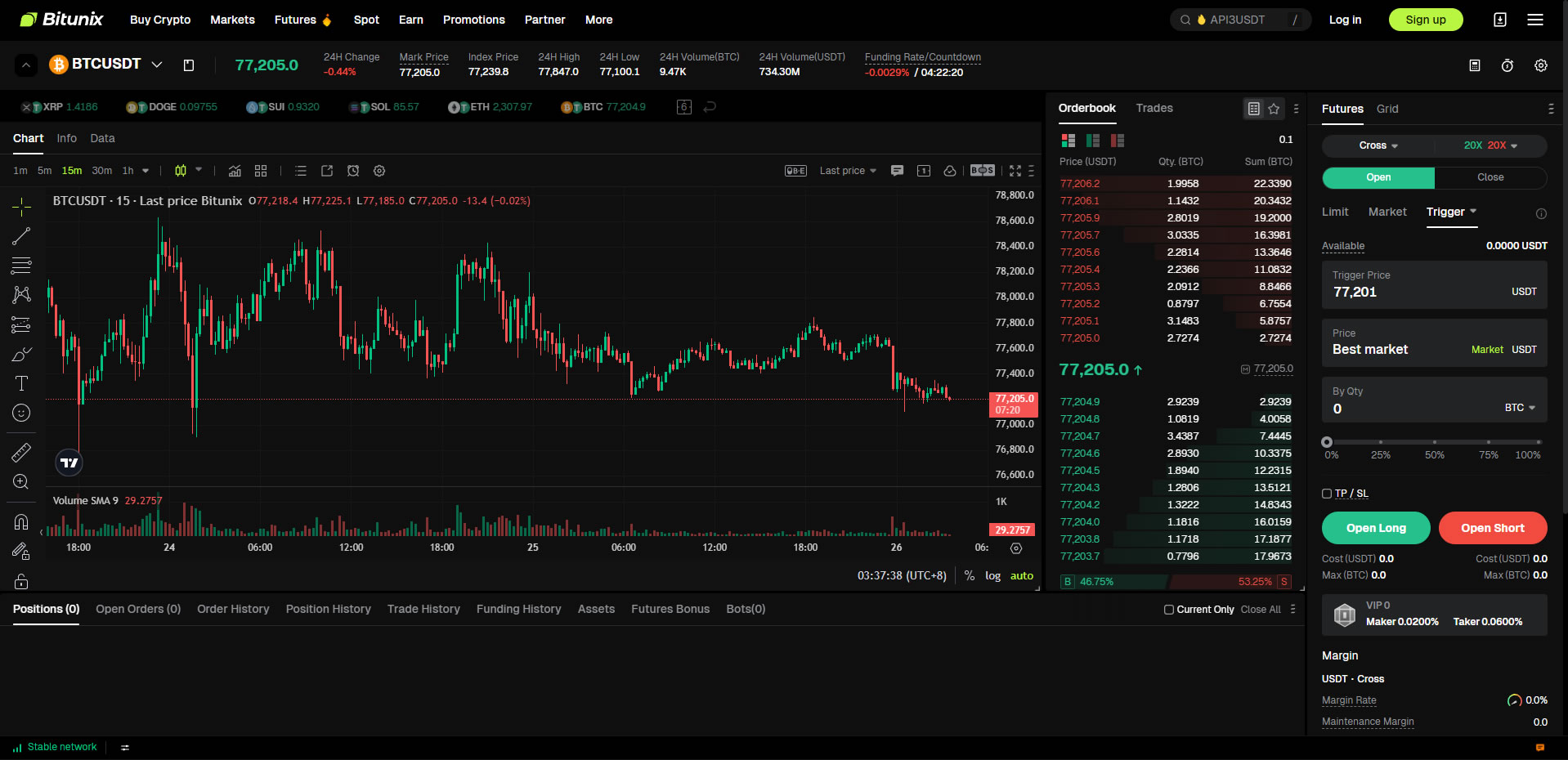
Features like the 16-chart layout, fixed-risk orders and multi-trade mode add another layer of depth. Traders can monitor multiple markets simultaneously and open several positions on the same pair in the same direction. These features are rarely found on other platforms.
Customer Support Channels
Bitunix offers several customer support channels, though availability can vary depending on the issue. The primary method of support is through a ticketing system, which is accessible directly from the platform. Response times are generally reasonable, though not always instant.
Live chat support is also available and tends to be the fastest way to resolve urgent issues. In addition, users can reach out via email for more detailed inquiries. The platform maintains an active presence on social media channels, which can also serve as informal support or communication channels.
A web-based help center is available and includes FAQs, guides, and troubleshooting articles. While it may not cover every edge case, it does a decent job of addressing the most common questions and problems users encounter.
Supported Languages
Bitunix supports multiple languages, making it accessible to a global user base. The platform continues to expand its language offerings as it grows into new markets.
Currently supported languages (16):
5. Safety & Security
Company Info and Overview
Bitunix operates as a centralized cryptocurrency exchange with a growing global presence, particularly among derivatives traders. While it is not as widely recognized as some industry giants, it has steadily built a reputation as a reliable and user-focused platform. Its growth has been driven largely by competitive fees, strong feature development, and a focus on accessibility.
The company positions itself as a privacy-friendly exchange, which explains its optional KYC approach and high withdrawal limits. This strategy appeals to a specific segment of users who prefer fewer barriers to entry and more control over their personal data. At the same time, the platform still implements standard compliance and security measures expected from a centralized exchange.
Transparency is gradually improving, with Bitunix introducing features like proof of reserves and public-facing security practices. While it does not yet have the same level of public disclosure as top-tier exchanges, it shows clear intent to build trust over time through incremental improvements.
Regulatory Compliance and Licenses
Bitunix holds basic Money Services Business registrations in United States and Canada. These licenses allow it to provide basic money transfer operations, though they are not as comprehensive as full exchange licenses in stricter jurisdictions. For many users, this level of compliance is considered acceptable given the platform’s overall offering.
It is important to note that exchanges offering optional or no KYC often face significant regulatory hurdles. In many regions, obtaining full licensing while maintaining user anonymity is either extremely difficult or outright impossible. As a result, Bitunix’s current regulatory status is fairly typical for platforms that prioritize accessibility and privacy.
While this may raise concerns for users who prefer heavily regulated environments, it is largely in line with competitors in the same category. Users should weigh the tradeoff between regulatory oversight and account restrictions when deciding if the platform suits their needs. On the upside, the exchange doesn’t restrict access to staking or derivatives based on user location, meaning all features are equally available to all users.
Available and Restricted Countries
Bitunix is available in a wide range of countries, making it accessible to a global audience. Its reliance on third-party fiat gateways further expands its reach, allowing users in regions with limited banking support to still participate in crypto markets.
However, like most exchanges, it restricts access in certain jurisdictions due to regulatory requirements. This typically includes countries with strict financial regulations or sanctions, where offering services could expose the platform to legal risks.
Bitunix is available in a total of 200 countries, and restricts users from 25 countries. Restricted countries include Afghanistan, Canada, Central African Republic, China, Congo - Kinshasa, Cuba, France, Guinea-Bissau, Haiti, Hong Kong, Iran, Iraq, Lebanon, Libya, North Korea, Singapore, Somalia, South Korea, South Sudan, St. Martin, Sudan, Syria, United Arab Emirates, United States, and Yemen.
Users are encouraged to review the latest country availability list4 before signing up, as restrictions can change over time. This is especially important for those using VPNs or traveling frequently between regions.
Platform and Funds Safety
Bitunix implements several standard and advanced security measures to protect user funds and platform integrity. A significant portion of user assets is stored in cold wallets, which are kept offline and protected from external threats. This reduces the risk of large-scale hacks affecting the majority of funds.
The platform also integrates with Fireblocks5, a well-known digital asset custody and security infrastructure provider. This adds an additional layer of protection for transactions and wallet management, particularly for institutional-grade security practices. This partnership combined platform’s ISO/IEC 27001:20226 security certification along with regular independent security audits helps strengthen the overall safety framework.
Bitunix maintains a proof of reserves7 system, allowing users to verify that the platform holds sufficient assets to cover user balances. It also operates a $40M+ insurance fund8 designed to mitigate losses from extreme market conditions, particularly in futures trading. Notably, there have been no publicly reported hacks or major security breaches, which is a positive sign for a relatively young exchange.
A bug bounty program is also in place, encouraging security researchers to report vulnerabilities. This proactive approach helps identify and resolve potential issues before they can be exploited.
User Account Security
On the user side, Bitunix offers a solid set of account protection features. Two-factor authentication is supported and strongly encouraged, adding an extra layer of security beyond just a password. Users can also enable withdrawal address whitelisting, which ensures funds can only be sent to pre-approved addresses.
Additional protections include anti-phishing codes, which help users verify official communications from the platform. Device management tools allow users to monitor and control which devices have access to their accounts, while login history provides visibility into recent account activity.
While these features cover most essential security needs, Bitunix does not offer some additional layers found on other platforms, such as trading passwords or separate fund passwords. For most users, this will not be a dealbreaker, but those seeking maximum granular control may notice the absence.
6. Conclusion
Bitunix is a practical, low-cost exchange with a strong focus on derivatives trading and user accessibility. It doesn’t try to compete on sheer scale, but instead delivers a streamlined experience with competitive pricing and useful features. For many users, that focused approach is exactly what makes it appealing.
Who It’s Best For (and Not For)
- Beginners: Simple interface, copy trading, and recurring purchases make it easy to get started
- Active traders: Low fees, high-volume futures markets, and advanced tools suit frequent trading
- Privacy-focused users: Optional KYC with high withdrawal limits is a major advantage
- Intermediate traders: Strong balance of usability and features without overwhelming complexity
- Users in underserved regions: Wide fiat access through gateways and local payment methods
- Traders who rely on technical analysis: Built-in chart alerts and multi-chart layouts add real value
- Passive investors: Staking and automation exist, but options are somewhat limited
- TradFi traders: Only a small selection of stocks, indices, and commodities
- Advanced DeFi users: No on-chain trading or decentralized features
- Beginner traders: No paper trading environment to test strategies
- All-in-one finance users: No crypto loans or broader financial services
Final Verdict
Bitunix does not try to be everything at once, and that works in its favor. It focuses on delivering a solid trading experience with low fees and a clean interface, rather than overwhelming users with unnecessary features. This makes it particularly appealing to traders who value efficiency and simplicity.
Its derivatives platform is clearly the centerpiece, offering enough depth and flexibility for active traders without becoming overly complex. Features like multi-trade mode and advanced chart alerts give it an edge in usability, especially for those who rely heavily on technical analysis.
At the same time, the platform covers enough ground to remain useful for casual users. Spot trading, staking, and recurring purchases provide a well-rounded baseline, even if the overall ecosystem is not as expansive as larger competitors.
There are some gaps, particularly in areas like margin trading, lending, and broader financial services. However, these omissions feel intentional rather than accidental, as Bitunix appears focused on refining its core offering instead of stretching too thin.
Overall, Bitunix is a strong choice for traders who want low fees, solid tools, and fewer barriers to entry. It may not replace the biggest exchanges for everyone, but it earns its place as a reliable and efficient alternative.
Sources and references:
- VIP benefits and requirements: https://www.bitunix.com/activity/bitunix-plan ↩︎
- What is Bitunix futures bonus: https://www.bitunix.com/hub/helpcenter/article/what-is-bitunix-futures-bonus?id=138 ↩︎
- Bitunix Card: https://support.bitunix.com/hc/en-us/articles/60109719218713-Introducing-Bitunix-Card-A-Smarter-Way-to-Use-Your-USDT ↩︎
- Restricted regions and user eligibility notice: https://support.bitunix.com/hc/en-us/articles/44799698894873-Bitunix-Restricted-Regions-and-User-Eligibility-Notice ↩︎
- Fireblocks and Elliptic partnership: https://support.bitunix.com/hc/en-us/articles/53215228360217-Bitunix-Integrates-Fireblocks-and-Elliptic-Elevating-Security-and-Compliance-to-Institutional-Grade ↩︎
- ISO/IEC 27001:2022 certification: https://support.bitunix.com/hc/en-us/articles/56831026289561-Bitunix-Achieves-ISO-IEC-27001-2022-Certification-Demonstrating-Unwavering-Commitment-to-Global-Security-Standards-and-User-Trust ↩︎
- Proof of reserves: https://www.bitunix.com/proof-of-reserve ↩︎
- Bitunix care fund: https://www.bitunix.com/hub/academy/course/bitunix-care-fund?id=67 ↩︎

All reviews submitted are moderated. Negative opinions are fine. Spam, competitor promotion, false claims, FUD or unsubstantited criticism is not approved.