











1. Exchange Overview
Poloniex ranks among the older crypto exchanges still active today. It launched in 2014 and built its name during the early altcoin boom, when few platforms offered deep access to smaller tokens. That legacy still shapes its identity, as it continues to list a good number of trading pairs that appeal to users chasing niche markets.
Ownership changes have also played a role in its direction. The exchange was once acquired by Circle, then later spun off and linked to investors associated with Justin Sun, founder of TRON. This connection shows up in the platform’s integration with TRON-based assets and its native token incentives, which lean heavily toward that ecosystem.
Nowadays, Poloniex is mainly considered as an alternative crypto-only exchange. The platform focuses on spot and very basic derivatives trading rather than building a broad financial ecosystem with fiat banking or traditional assets.
Despite its age, Poloniex remains relevant mostly because of its wide altcoin selection and relatively simple interface. It does not try to compete with the largest exchanges on features, but instead leans into accessibility and a familiar trading experience. For users who want exposure to a wide range of tokens, it still fills a niche.
- Long operating history since 2014
- Good selection of altcoins with 700+ trading pairs
- Competitive futures trading fees
- TRX token discount reduces spot fees by 30%
- Simple and easy-to-use interface
- Cold storage and proof of reserves in place
- No direct fiat deposits or withdrawals
- Very small number of futures altcoin pairs
- Spot trading fees higher than some competitors
- Weak P2P liquidity in many regions
- Lacks advanced trading tools and automation
- No anti-phishing codes or advanced account protections
- No regulatory licenses or oversight
- Missing features like loans, launchpad, or demo trading
2. Fiat Deposits, Withdrawals and Fees
Poloniex does not support direct fiat deposits or withdrawals. Users cannot link a bank account or card directly to the exchange, which puts it behind platforms that offer full fiat integration. Instead, it relies entirely on third-party services and peer-to-peer trading for onboarding and offboarding funds.
Integrated Fiat Gateways
To assist users with fiat on-ramp or off-ramp, Poloniex integrates several 3rd party fiat gateways. These include providers like Simplex and Mercuryo, which allow users to purchase crypto using cards or other payment methods. Fees and availability vary depending on the provider, region, and payment method used.
 Visa/Mastercard
 ACH Transfers (US/USD)
 SEPA Transfers (EU/EUR)
 Google Pay
 Apple Pay
 Other Bank Transfers
 Revolut Pay
While these services make access possible, they come with higher fees than native fiat support. Users often pay a noticeable premium for convenience, especially when using debit or credit cards. Still, for occasional purchases, the process is straightforward and works reliably.
P2P Market
Poloniex also offers a peer-to-peer marketplace where users can trade crypto directly with each other. The platform supports multiple payment methods, including bank transfers, digital wallets like Neteller or Skrill, and services such as Paysend or Mobile Money. This gives users flexibility, especially in regions with limited fiat infrastructure.
That said, activity levels are relatively low compared to major P2P platforms. Liquidity can vary significantly depending on the country and payment method, which may lead to slower trades or less competitive pricing. For users who depend heavily on P2P, more active marketplaces will likely offer a better experience, though Poloniex can still work in certain cases.
3. Trading Markets and Fees
Crypto Trading Markets
Poloniex supports several core trading markets:
- Spot Trading: This is the platform’s strongest offering, with more than 700 trading pairs available. It includes a wide mix of major cryptocurrencies and lesser-known altcoins, making it attractive for traders seeking variety.
- Margin Trading: Available on select pairs, margin trading allows users to borrow funds and increase position size. However, the selection is limited to mainstream large-cap assets.
- Futures Trading: Poloniex offers perpetual futures contracts with leverage, but only for around a dozen assets. This makes it suitable for trading major coins, but not ideal for users who want exposure to a broad range of derivatives markets.
The platform does not support options trading, on-chain trading features, or traditional finance products like stocks or ETFs. Its focus remains strictly on core crypto markets. While it does have Futures trading, users who are looking for extensive trading pairs and high leverage will likely also be disappointed.
Trading Fees
Poloniex uses a straightforward fee structure1. Spot trading fees are set at 0.2% for both makers and takers, which sits around the industry average. However, many competing exchanges now offer lower base rates, often around 0.1%, making Poloniex slightly more expensive for spot traders.
Futures trading fees are more competitive, with 0.015% for makers and 0.05% for takers. These rates fall slightly below industry averages, which can benefit high-frequency or derivatives traders.
Users can reduce spot trading fees by using TRX, the native token of the TRON ecosystem, which offers a 30% discount. VIP levels are also available, and the entry threshold is relatively low. Traders with $10,000 in spot volume or $100,000 in futures volume over 30 days can unlock meaningful fee reductions. By using our referral code during signup, users can additionally get a permanent 10% fee rebate.

Other Trading Features
- Copy Trading: Poloniex includes a copy trading feature, but activity is relatively low. Users may find limited strategy variety and fewer experienced traders to follow.
- Subaccounts: Traders can create subaccounts to separate strategies or manage multiple portfolios under one main account. This is useful for more organized trading setups.
- Trading Bots: The platform offers basic automation tools, including spot and futures grid bots. These are easy to use but lack the depth found on more advanced platforms.
- Futures Earn: A less common feature, Futures Earn allows users to generate yield on idle futures balances. It provides a way to earn passive income without actively trading.
Poloniex lacks several features that have become standard elsewhere. There is no demo trading environment, no recurring or scheduled buying, and no advanced automation tools beyond grid bots.
Other Features and Services
Poloniex keeps its extra features fairly limited. It focuses on a few core services rather than trying to cover every corner of the crypto space. That approach keeps things simple, though some users may find the offering a bit thin.
- Staking: Poloniex supports staking for around a dozen cryptocurrencies. Users can earn passive rewards by locking supported assets directly on the platform, without needing external wallets. The selection is small compared to leading exchanges, but it covers a few well-known coins and offers a simple, hands-off experience.
Identity verification on Poloniex used to be optional, but after June 10, 20262 is mandatory for all withdrawals. Users used to be able to trade spot markets without completing KYC, which appealed to privacy-focused traders.
Poloniex does not offer many additional financial services that are common elsewhere. There are no crypto loans, no savings accounts beyond basic staking, no launchpad for new tokens, and no crypto debit or ATM cards. The platform sticks to essentials rather than building a full-service ecosystem.
4. User Experience
Poloniex delivers a straightforward user experience that leans more toward function than flair. The platform avoids unnecessary complexity, which makes it approachable for new users, but it will feel basic to experienced traders. Both the website and mobile app follow a consistent design, with a full dark mode available across the interface.
Overall User Experience
The interface is clean and easy to understand, even for first-time users. Navigation is simple, with clearly labeled sections for markets, wallets, and trading tools. While customization options exist, they are fairly limited compared to more advanced platforms.
Educational resources are present but not extensive. Users will find basic guides and help articles, though there is no deep learning hub or structured tutorials. For most users, the platform feels intuitive enough to use without much guidance.
Trading User Interface
The trading interface covers all essential tools without going overboard. Users get access to standard charting powered by TradingView, along with common order types like market, limit, and stop-limit orders. The layout is functional, and surprisingly sufficiently customizable. Various trading panels can be resized, moved or completely hidden, giving users a solid degree of personalization.
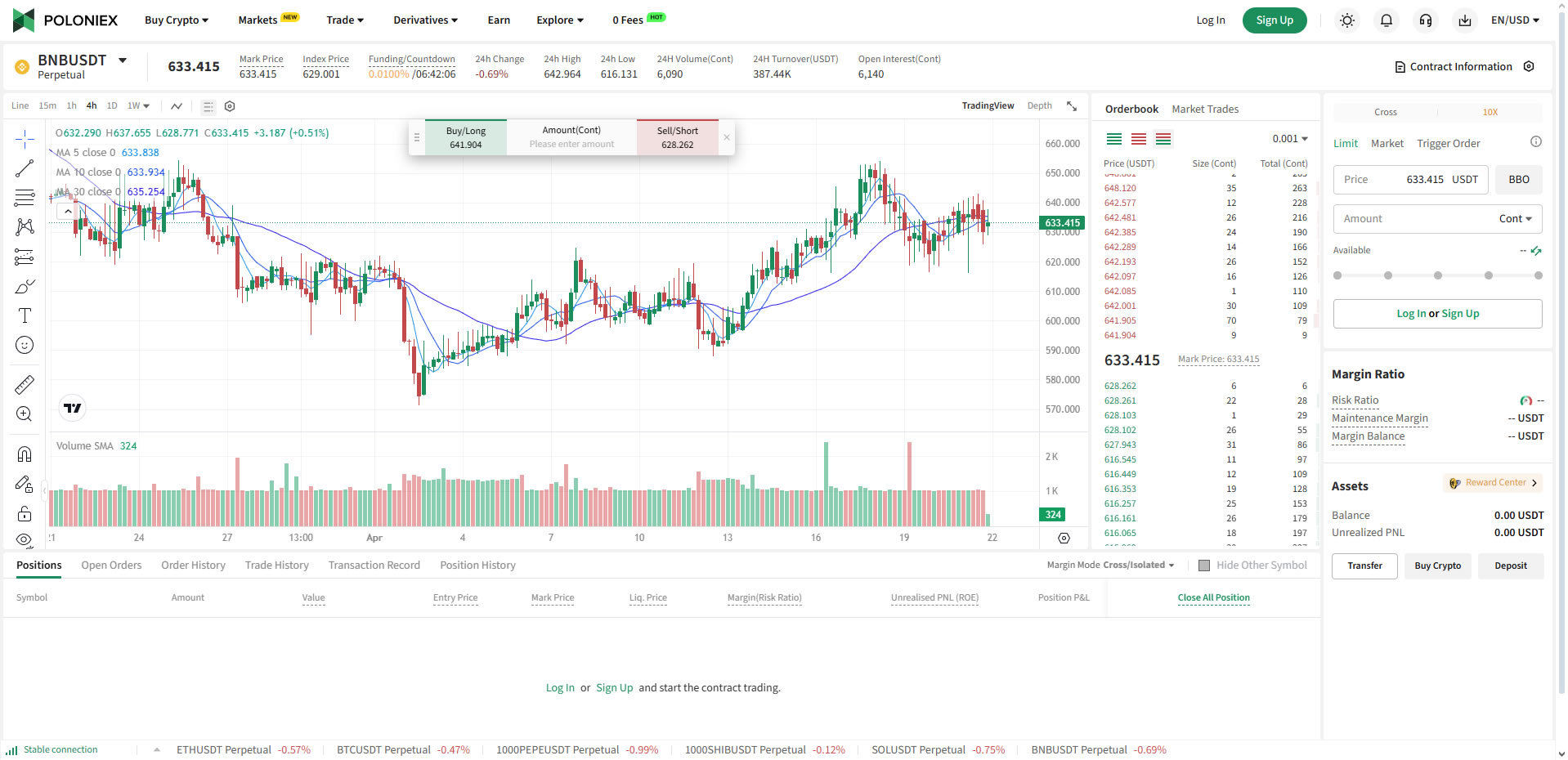
Advanced traders may find the interface somewhat restrictive, though. Features like multi-chart layouts or advanced order types (Iceberg, TWAP, etc.) are missing. Still, for basic and intermediate trading, it performs reliably and remains easy to use.
Customer Support Channels
Poloniex offers several support options, though availability can vary. Users can contact support through a ticket system and access a web-based help center with FAQs and guides. Email support is also available for more direct communication.
There is no phone support. Live chat support may be available in certain regions or situations, but it is not a core feature. Social media channels are active, though they are not a substitute for formal support when dealing with account issues.
Supported Languages
Poloniex supports multiple languages to serve its global user base:
5. Safety & Security
Company Info and Overview
Poloniex is one of the longest-running crypto exchanges still operating. Since its launch in 2014, it has gone through several ownership changes and strategic shifts. Its association with figures linked to the TRON ecosystem has shaped its current direction, especially in terms of supported assets and integrations.
The company does not maintain the same level of public transparency as some top-tier exchanges. Leadership visibility and corporate structure details are limited, which may concern users who prefer clearly defined governance. Still, its long operating history gives it some credibility in a market where many platforms come and go quickly.
Regulatory Compliance and Licenses
Poloniex does not hold any widely recognized regulatory licenses. This is not entirely unusual for no-KYC or offshore exchanges, as strict compliance requirements often conflict with anonymous trading models. However, even within that privacy category, many competitors manage to secure at least some limited licenses or registrations. Poloniex implemented mandatory KYC fairly recently in June 2026.
The lack of regulatory coverage means users operate with fewer protections. There is no clear oversight from major financial authorities, and dispute resolution options are limited. For risk-conscious users, this is an important factor to consider before using the platform.
Available and Restricted Countries
Poloniex operates globally but restricts access in certain jurisdictions due to regulatory concerns. Availability depends on local laws and compliance requirements, which can change over time.
Poloniex is available in a total of 207 countries, and restricts users from 18 countries. Restricted countries include Afghanistan, China, Congo - Kinshasa, Cote d’Ivoire, Cuba, Iran, Iraq, Libya, Mali, Myanmar, North Korea, Palestine, Somalia, Sudan, Syria, United States, Yemen, and Zimbabwe.
Users should always verify whether the platform is accessible in their country before signing up.
Platform and Funds Safety
Poloniex has implemented several measures to protect user funds. The exchange states that around 90% of assets are stored in cold wallets, reducing exposure to online threats. It also provides proof of reserves3, which adds a level of transparency regarding asset backing.
The platform experienced a limited hack incident in 2023, but it reported that no user funds were lost. In addition, Poloniex maintains a $100 million insurance fund designed to cover potential losses from hacks or security breaches. A bug bounty program4 is also in place to encourage responsible disclosure of vulnerabilities.
In terms of market presence, Poloniex typically ranks within the top 40 exchanges by spot trading volume. While not a market leader, it remains active enough to maintain liquidity and operational stability.
User Account Security
Poloniex includes several standard account security features. Users can enable two-factor authentication through Google Authenticator, SMS, or passkeys, which adds an extra layer of protection during login and withdrawals. Withdrawal address whitelisting is also available to prevent unauthorized transfers.
Additional tools include device management, account activity tracking, and login notifications via email. Users can also freeze their accounts if suspicious activity is detected, which helps limit potential damage.
However, some commonly expected features are missing. Poloniex does not offer anti-phishing codes, which are now standard on most exchanges. It also lacks advanced protections like trading passwords or separate withdrawal PINs, which could improve overall account security.
Is Poloniex Safe or Unsafe?
Poloniex sits somewhere in the middle when it comes to safety. Its long history, cold storage practices, and insurance fund all work in its favor. The presence of proof of reserves and a bug bounty program also suggests a baseline commitment to security.
At the same time, the lack of regulatory oversight and limited transparency cannot be ignored. Missing account-level protections, such as anti-phishing codes, may raise concerns for more security-focused users. These gaps make it less robust than top-tier exchanges with stronger compliance and security frameworks.
For many users, especially those comfortable with offshore platforms, Poloniex offers an acceptable level of safety. However, those prioritizing maximum protection and regulatory backing may prefer alternatives with stricter oversight and more advanced security features.
6. Conclusion
Poloniex remains a recognizable name in crypto trading, especially after more than a decade in the market. It does not try to reinvent the wheel, and that works in its favor for users who want a familiar, no-frills trading experience. The platform focuses on core functionality, with a strong emphasis on altcoin access and simple onboarding.
At the same time, it shows its age in certain areas. Feature depth, regulatory clarity, and advanced tools fall behind leading exchanges. Still, for a specific type of user, Poloniex continues to do the job without unnecessary complications.
Who It’s Best For (and Not For)
- Beginners: Simple interface makes it easy to get started, but lack of direct fiat options can increase onboarding costs through third-party gateways.
- Active Spot Traders: Strong fit for users trading altcoins, thanks to a large selection of over 700 spot pairs and low fees.
- Altcoin Hunters: Works well for users looking beyond major tokens, with steady access to smaller and niche assets.
- Occasional Traders: Suitable for users who trade sporadically and do not need advanced tools or deep liquidity.
- Futures-Heavy Traders: Limited futures coverage with only a small number of supported assets restricts strategy options.
- High-Volume Professionals: Better fee structures, liquidity, and execution tools are available on larger exchanges.
- Passive Investors: Staking options are limited and there are no strong yield or savings products.
- Fiat-First Users: No direct bank deposits or withdrawals, which makes fiat onboarding slower and more expensive.
- Advanced Strategy Traders: Lacks features like demo trading, complex order types, and broader automation tools.
Final Verdict
Poloniex works best when judged for what it is: a straightforward crypto exchange that focuses on basic trading rather than building a full financial ecosystem. Users who value simplicity and access to a good range of altcoins will likely find it useful.
Its biggest strength lies in its spot market. With 700+ altcoins it offers sufficient variety, and plenty of smaller tokens. This alone keeps it relevant among traders who look beyond major cryptocurrencies.
However, the platform does not keep pace in several key areas. Futures traders have very limited trading options, and the lack of fiat support adds friction for onboarding. Security features also feel slightly outdated compared to industry leaders.
In the end, Poloniex fits a niche rather than a broad audience. It suits users who want a simple, crypto-only platform, but very few features and lack of liquidity make most alternatives seem better. Those looking for a more advanced, regulated, or feature-rich experience will likely need to look elsewhere.

All reviews submitted are moderated. Negative opinions are fine. Spam, competitor promotion, false claims, FUD or unsubstantited criticism is not approved.