













1. Exchange Overview
HTX is a global cryptocurrency exchange that has gone through a major rebranding and strategic shift in recent years. Previously known as Huobi Global, the platform is now a full-service digital asset ecosystem with a stronger focus on derivatives trading, yield products, and international expansion. Despite the name change, much of the core infrastructure and trading engine remains familiar to long-time users, which helps maintain continuity while introducing new features.
One of HTX’s biggest selling points is its wide product suite that goes beyond simple spot trading. The platform combines spot markets, derivatives, staking products, and structured investment tools into a single interface, aiming to serve both active traders and passive investors. Liquidity remains strong across major trading pairs, and the exchange continues to rank among the more established players in the global crypto market, especially in Asia and emerging markets.
Another notable aspect is HTX’s focus on accessibility for global users, even in regions where direct banking integrations are limited. Instead of relying heavily on in-house fiat rails, the exchange leans on third-party payment providers and peer-to-peer infrastructure to onboard users. This approach allows HTX to serve a broader international audience, though it can sometimes result in a less streamlined fiat experience compared to exchanges with native banking support.
At the same time, HTX is a derivatives-first platform, with a strong emphasis on futures trading and advanced financial products. While beginners can still use the platform, the overall structure, product depth, and fee incentives are clearly designed with more experienced traders in mind. This makes HTX particularly attractive to users looking for leverage, advanced order types, and yield optimization strategies rather than simple buy-and-hold investing.
- Very popular derivatives trading platform with high leverage options
- Wide range of financial products including staking and structured investments
- Competitive fees with VIP tiers and token-based discounts
- Global accessibility through P2P and third-party fiat gateways
- Solid liquidity across major trading pairs
- Fiat withdrawals rely entirely on third-party providers
- Interface may overwhelm beginners
- Very few regulatory licenses
- P2P marketplace smaller than top competitors
- Limited TradFi offerings beyond basic commodities
- Only basic trading UI customization available
2. Fiat Deposits, Withdrawals and Fees
Direct Payments
| Payment method | Supported currencies | Deposit fee | Withdrawal fee |
|---|---|---|---|
| Visa and Mastercard | Any supported | 1.40% + $0.75 | Not available |
| ACH bank transfer | USD | 0% - 1.5% | Not available |
| SEPA bank transfer | EUR | 0.15% + 1 EUR | Not available |
| Skrill | Any supported | 2.9% + 0.1% | Not available |
HTX supports multiple direct fiat payment methods, including credit and debit cards, bank transfers such as SEPA and ACH, and selected e-wallet options like Skrill. These options allow users to purchase crypto directly on the platform, though availability often depends heavily on the user’s country of residence. While the exchange itself is accessible in many regions, fiat services may still be restricted in countries like Japan, Singapore, Germany, or Turkey due to local regulations or third-party provider limitations.
Fiat payments on HTX are often too restrictive, and there’s very little information about current availability on the website. Only logged-in and verified users can confirm availability. Finding a different exchange for fiat services will likely result in smoother onboarding.
It is important to note that while deposits can be made through these direct methods, fiat withdrawals are not handled natively by HTX. Instead, users must rely on third-party gateways to convert crypto back into fiat and withdraw funds. This adds an extra step to the process and can introduce additional fees, making HTX less convenient for users who frequently move between crypto and traditional banking systems.
3rd Party Gateways
 Visa/Mastercard
 SEPA Transfers (EU/EUR)
 SWIFT Transfers (International)
To bridge the gap between crypto and fiat withdrawals, HTX integrates a third-party payment gateway Volet. This service allows users to sell their crypto holdings and withdraw fiat to external accounts, effectively acting as intermediaries between the exchange and traditional financial systems. While functional, this setup means users must interact with an additional platform with its own separate identity verification system.
P2P Market
HTX also offers a peer-to-peer (P2P) marketplace where users can buy and sell cryptocurrencies directly with each other using local payment methods. This option is particularly useful in regions with restricted banking access, as it allows for diverse payment methods and local currency support. The platform includes escrow protection to help ensure that both parties fulfill their obligations during a transaction.
However, compared to some larger competitors, HTX’s P2P marketplace doesn’t have the deepest pool of merchants or the widest selection of offers. The number of active buyers and sellers can vary depending on the currency and region, which may impact pricing. As of our latest check, most of the trading on HTX’s P2P market seems to be in Chinese Yuan. If you intend to buy crypto with AliPay or WeChat, HTX is the place to check.
3. Crypto Markets and Fees
HTX is a multi-market trading platform with a strong tilt toward derivatives and high-frequency trading. The exchange offers a wide selection of markets and instruments, making it suitable for users who want more than just basic spot trading. With hundreds of assets and deep liquidity on major pairs, HTX appeals especially to traders who want access to both mainstream and newly listed tokens.
Crypto Trading Markets
- Spot Trading: Spot trading on HTX allows users to buy and sell crypto at current market prices with direct ownership of assets. The platform supports ~700 coins and over a thousand trading pairs, giving users access to both major assets and smaller altcoins. Liquidity is generally strong on top pairs like BTC and ETH, although smaller tokens can have thinner order books.
- Margin Trading: HTX offers margin trading with leverage, allowing users to borrow funds and increase position sizes. Traders can choose between cross and isolated margin modes, with leverage typically up to 5x depending on the asset. This feature is integrated directly into the spot interface, making it easy to switch between regular and leveraged trading.
- Futures Trading: Futures and perpetual contracts are one of HTX’s strongest areas, with leverage reaching up to 200x on some instruments. Volume and liquidity is within top 15, however only about ~250 trading pairs are available. This market is clearly a core focus of the platform and one of its main competitive advantages.
- Options Trading: HTX provides access to options-style products and structured derivatives, although the selection is more limited compared to major derivatives exchanges. These products are designed for advanced users looking to hedge positions or speculate on volatility. While not the platform’s primary strength, they still add another earning avenue for experienced traders.
- TradFi: HTX has begun experimenting with traditional financial instruments, mainly through tokenized commodities and precious metals. However, this offering remains very limited in scope and is not yet a major part of the platform. For now, it feels more like an early-stage feature than a fully developed market segment.
Trading Fees
HTX uses a relatively standard fee structure1, with base spot trading fees at 0.2% for both makers and takers. These fees can be reduced through higher trading volumes (which provide tiered discounts and VIP benefits), or by holding the platform’s native token (25% discount).
For futures trading, fees are generally lower than spot, which is common across the industry to encourage high-volume trading. HTX’s default Futures fees are 0.02% for maker orders and 0.06% for taker orders, which is identical to most platforms. HTX token can be used for a ~5% rebate. The platform also offers VIP tiers that reward frequent traders with progressively lower fees, along with occasional promotions and referral discounts. This structure makes HTX more cost-efficient for active traders than casual users who only trade occasionally.
The easiest way to reduce trading fees on both spot and futures markets is through a referral code. Using “yt829223” during signup will apply a permanent 10% fee reduction to your account, and comes at no cost or drawback.

In addition to a fee reduction, new signups using referral codes will also receive a Mystery Box with up to $1,500 in crypto.
Other Trading Features
HTX includes several additional tools aimed at advanced users and automation-focused traders:
- Copy Trading: Users can follow and replicate the trades of experienced traders, making it easier to participate in the market without active management. This feature is particularly useful for less experienced users who still want exposure to more complex strategies.
- Subaccounts: HTX supports subaccounts, allowing users to manage multiple trading strategies or portfolios under one main account. This is especially useful for professional traders and institutions who need to separate risk or track performance across strategies.
- Trading Bots: The platform offers automated trading tools such as grid bots and Martingale bots. These tools allow users to set predefined trading rules and execute trades continuously without manual intervention, which is ideal for range-bound markets or passive strategies.
Other Financial Features and Services
Beyond trading, HTX provides a range of financial products designed to generate passive income or improve capital efficiency:
- Staking: HTX supports both flexible and fixed staking options, allowing users to earn yield on supported assets. Rewards vary depending on the asset and lock-up period, with some products offering relatively high returns.
- Sharkfin Products: These are structured investment products that combine fixed income with exposure to market volatility. Returns depend on price movement within a predefined range, making them more complex but potentially more profitable than standard staking.
- Dual Investment: Dual investment products let users commit funds in one asset while earning yield based on price conditions of another asset. This is aimed at users comfortable with conditional outcomes and market timing.
- On-chain Staking: HTX also integrates on-chain staking for certain assets, allowing users to participate in blockchain validation mechanisms directly through the platform. This provides a more native staking experience compared to exchange-managed products.
- Liquid Restaking: Some assets can be restaked while maintaining liquidity through derivative tokens, enabling users to earn yield while still having tradable exposure. This is a newer feature and not available for all assets.
- Crypto Loans: HTX offers crypto-backed loans, allowing users to borrow funds by using their crypto holdings as collateral. This can be useful for accessing liquidity without selling assets, though it carries liquidation risk if collateral values drop.
Overall, HTX delivers a feature-rich trading environment that leans heavily toward experienced users. The combination of derivatives, automation tools, and structured products makes it more than just a standard exchange, though it may feel overwhelming for beginners.
4. User Experience
HTX delivers a user experience that clearly targets active traders rather than casual users. The platform packs a large number of features into both its web interface and mobile app, which can feel dense at first glance but becomes more manageable with use. While beginners may find the layout slightly overwhelming, experienced traders will appreciate the level of familiarity and polish.
Overall User Experience
The overall experience on HTX is functional and efficient, though not the most beginner-friendly. The account dashboard allows users to quickly access markets, balances, and financial products, but sadly not in a fully dark color scheme. Essential educational content exists through guides and help articles, but it’s not as prominently featured or beginner-focused as on some competing platforms.
The mobile app has much of the desktop functionality, which is a strong point for users who trade on the go. It supports full account management, trading, and access to financial products without major limitations. However, just like the desktop version, the app leans toward experienced users and may require some time to get comfortable with.
Trading User Interface
HTX’s trading interface is functional and familiar, especially for derivatives traders. The platform integrates advanced charting tools powered by TradingView, allowing users to perform technical analysis directly within the exchange. The interface supports basic order types including limit, market, stop-limit, TP/SL, and trigger orders.
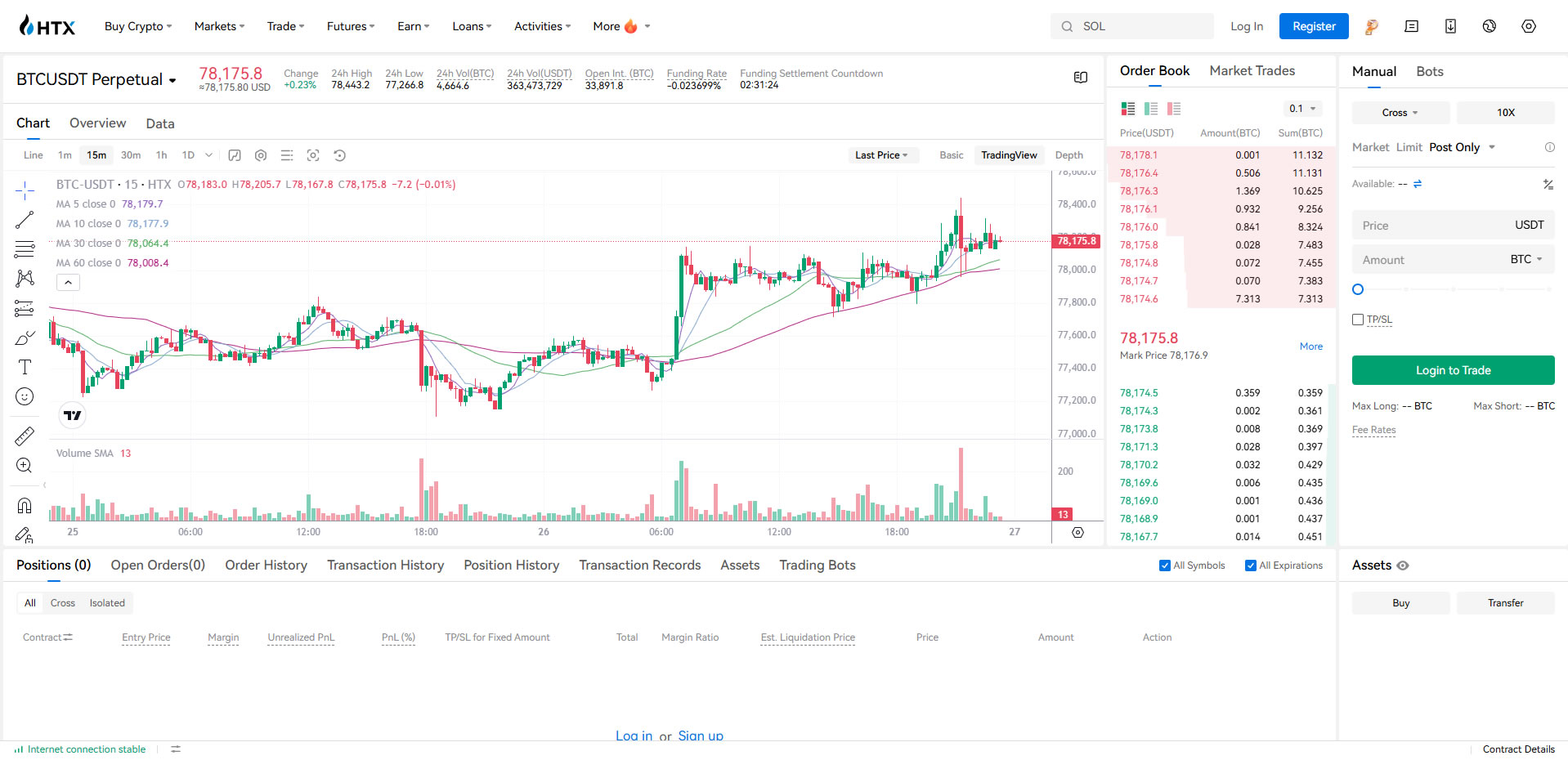
Customization plays a big role here, as users can’t really adjust chart layouts and trading panels to fit their workflow. The interface allows switching between simplified and advanced views (Pro and Classic), but panels and chart can’t be moved or resized, which is a disappointing lack of customization usually available even on far less popular platforms.
Overall there’s nothing specifically missing in the trading UI and experienced users will immediately feel comfortable, but it needs more customization options. We expected more from a platform so focused on crypto trading.
Customer Support Channels
HTX provides several customer support options, though availability and response quality can vary. Users can reach support through email and a ticketing system, which is the primary method for resolving account or transaction issues. A live chat feature is also available, but response times may depend on demand and region.
In addition, HTX maintains a help center with basic FAQs and troubleshooting guides, along with active social media channels for announcements and updates. Phone support is not typically offered, which may be a drawback for users who prefer direct communication. Overall, support is adequate but not a standout feature compared to top-tier exchanges.
Supported Languages
HTX supports a wide range of languages, making it accessible to a global audience. The platform includes major languages such as English, Chinese, Spanish, Russian, and several others, which helps cater to its diverse user base.
Currently supported languages (13):
This multilingual approach aligns with HTX’s international focus, although the quality of translations can occasionally vary depending on the section of the platform. In particular, some of the help center articles could use some polish.
5. Safety & Security
HTX is as a long-standing player in the crypto exchange space dating back to 2013, with roots going back to its earlier identity as Huobi Global. Over the years, it has built a sizable global user base and maintained operations through multiple market cycles, which adds a degree of credibility. That said, like many offshore exchanges, its structure and regulatory positioning can feel less transparent compared to fully licensed platforms in major jurisdictions.
Company Info and Overview
The exchange operates under the HTX brand, following its rebranding from Huobi, and is currently headquartered in the Seychelles. The platform serves users in many regions, but corporate location also means that local oversight and jurisdiction can be less straightforward. The platform has been associated with prominent figures in the crypto space, including Justin Sun, which has brought both visibility and controversy.
Regulatory Compliance and Licenses
HTX has taken steps to improve its regulatory standing in certain regions, although it’s not fully licensed in major markets like the United States or the United Kingdom. The platform has reportedly obtained a No Objection Certificate (NoC) from the Pakistan Virtual Asset Regulatory Authority (PVARA), signaling some level of regulatory engagement in that jurisdiction. HTX’s website mentions2 that they hold payment and remittance service licenses in South America, but it gives no specific details (such as actual countries where it holds these licenses).
The company’s overall compliance profile remains mixed, with operations often relying on regional entities and partnerships rather than a unified global license. This is fairly common among large international exchanges, but it does mean users should be aware of the legal environment in their own country before trading.
Available and Restricted Countries
HTX is available in a large number of countries, particularly across Asia, Eastern Europe, and parts of Latin America. However, like most global exchanges, it restricts access in certain jurisdictions due to regulatory requirements. These mostly include countries with strict crypto regulations or sanctions, and users may face limitations depending on their location.
HTX is available in a total of 214 countries, and restricts users from 11 countries. Restricted countries include China, Cuba, Hong Kong, Iran, North Korea, Singapore, Sudan, Syria, United Kingdom, United States, and Venezuela.
It is also worth noting that even in supported countries, some features such as fiat payments or specific financial products may not be available. This creates a situation where users can access the platform but still encounter regional restrictions on functionality. However, these restrictions are rare and mostly limited to fiat payments. In most cases users can access the full features of the platform without issues.
Platform and Funds Safety
HTX implements several standard security practices to protect user funds and platform integrity. A significant portion of user assets is stored in cold wallets, reducing exposure to online threats, while hot wallets are used for liquidity and day-to-day operations. The exchange has also introduced proof-of-reserves3 mechanisms to improve transparency, allowing users to verify that assets are backed.
In addition, HTX has historically maintained a security reserve fund intended to compensate users in the event of major breaches or incidents. While not equivalent to traditional insurance, this fund provides an extra layer of reassurance. The platform also conducts regular security audits and runs bug bounty4 programs to identify vulnerabilities. Furthermore, it uses industry leading Fireblocks for custody of funds5.
User Account Security
On the user side, HTX offers a solid set of account protection features. Two-factor authentication (2FA) is supported through apps like Google Authenticator, adding an extra layer of login security. Users can also enable withdrawal whitelist functionality, ensuring that funds can only be sent to pre-approved addresses.
Additional protections include anti-phishing codes in emails, trading passwords for order confirmation, and separate fund passwords for withdrawals. These layered controls help reduce the risk of unauthorized access, especially for users who take full advantage of the available security settings. While no exchange is completely risk-free, HTX provides the core tools needed to maintain a secure account when used properly.
Is HTX Safe or Unsafe?
HTX is generally considered safe in terms of core infrastructure, but it’s not without caveats. The platform uses standard industry protections like cold storage for most user funds, two-factor authentication, withdrawal whitelists, and internal risk controls. It has also introduced proof-of-reserves reporting, which adds a layer of transparency.
From a track record standpoint, HTX has operated for many years without a catastrophic collapse or major loss of user funds on the scale seen with some failed exchanges. That history works in its favor, even if it has faced occasional scrutiny and smaller security incidents over time. The platform has also maintained a security reserve fund intended to cover unexpected losses, which adds another layer of reassurance.
Where things become less clear is regulation and jurisdiction. HTX operates globally but doesn’t have strong licensing in top-tier regulatory regions, which may concern users who prioritize strict oversight. Its structure relies on multiple entities and regions, making legal protections less straightforward compared to heavily regulated exchanges.
So, is HTX safe or unsafe? It’s a legitimate exchange and won’t scam you, but strictly speaking about safety it sits somewhere in the middle. Technically and operationally, it provides solid security tools and has a long-running presence in the market. However, users should still approach it with the usual caution applied to offshore exchanges, avoid storing large long-term holdings on the platform, and make full use of account-level security features.
6. Conclusion
HTX sits in that category of exchanges that clearly know their audience. It doesn’t try to be everything for everyone, and that actually works in its favor. The platform focuses on trading depth, derivatives, and yield products, and it delivers well in those areas.
Who It’s Best For (and Not For)
- Active traders: HTX offers strong liquidity, advanced order types, and deep derivatives markets. It suits traders who execute frequently and need precision tools.
- Derivatives traders: High leverage with a functional futures interface makes HTX a good derivatives platform.
- Passive investors: Users looking for yield can explore staking, structured products, and lending without leaving the platform.
- Intermediate users: Those who understand crypto basics but want to slowly get more experience will find plenty of tools here.
- Beginners: The interface can feel crowded, and there is no demo trading or guided onboarding experience.
- Fiat-heavy users: Limited native fiat payments and reliance on P2P or third parties can make first crypto buying expensive and overly difficult.
- Long-term investors: There are easier platforms for simple buy-and-hold strategies.
- Users needing strict regulation clarity: Those who prefer fully licensed exchanges in major jurisdictions should look elsewhere.
Final Verdict
HTX works best when used for what it was clearly built for: active trading and capital efficiency. The order books are deep, trading volumes are high, and the fee structure rewards high-volume users. For traders who want leverage and lots of trading markets, it checks most boxes without much friction.
At the same time, the platform doesn’t try to simplify crypto for newcomers. It skips features like demo trading, scheduled buying and beginner walkthroughs, which makes the entry barrier higher than average. That choice feels intentional, not accidental.
The reliance on third-party fiat solutions is probably the biggest drawback. It works, but it adds extra steps and costs, which can get annoying over time. Users who frequently move between crypto and bank accounts may feel this more than others.
Still, HTX remains a strong contender as a top-tier crypto exchange. It’s not the easiest platform to start with, but it is one of the more capable ones once a user knows what they are doing. For derivatives-focused traders, it easily ranks among the better options available.
Sources and references:

All reviews submitted are moderated. Negative opinions are fine. Spam, competitor promotion, false claims, FUD or unsubstantited criticism is not approved.