













1. Exchange Overview
LBank is a long-running crypto exchange that has quietly built a large global user base since its launch in 2017. It focuses on offering a wide selection of trading markets, including both traditional crypto assets and more niche opportunities like memecoins and synthetic TradFi instruments. That mix makes it appealing to traders who want everything in one place without juggling multiple platforms.
One of LBank’s strongest selling points is its accessibility. The platform supports optional KYC, meaning users can start trading with minimal friction while still having the option to verify for higher limits. Combined with a simple onboarding process and support for multiple fiat onramps, LBank lowers the barrier to entry for new users while still offering enough depth for experienced traders.
Another key advantage is the sheer variety of features packed into the platform. Users can access spot and futures markets, copy trading tools, staking products, and even on-chain trading for decentralized tokens directly from the exchange interface. This reduces the need to interact with external wallets or DeFi platforms, which can be a major plus for users who prefer simplicity.
LBank also leans heavily into promotions and user incentives. New users are greeted with a wide range of bonuses, while ongoing trading competitions, deposit campaigns, and token splash events keep the platform active. It may not have the same brand recognition as the largest exchanges, but in terms of features and activity, it competes surprisingly well.
- Low spot trading fees at 0.1% maker and taker
- Wide range of markets including crypto, TradFi, and on-chain assets
- Optional KYC with relatively strong licensing compared to similar platforms
- Large selection of altcoins and memecoins
- Frequent promotions, bonuses, and trading competitions
- Built-in on-chain trading
- Copy trading and futures grid bot available
- Multiple fiat onramps and active P2P marketplace
- No direct fiat withdrawals, only via third-party gateways
- Lacks proof of reserves transparency
- No demo trading or recurring purchase features
- Limited advanced tools like subaccounts or institutional features
- Prepaid card is limited in functionality
- Some features may feel less polished than top-tier exchanges
2. Fiat Deposits, Withdrawals and Fees
Direct Payments
LBank supports direct fiat purchases through bank cards and bank deposits, which covers a good portion of global users looking for quick access to crypto. Card payments are the most straightforward option, allowing instant purchases with Visa or Mastercard.
| Payment method | Supported currencies | Deposit fee | Withdrawal fee |
|---|---|---|---|
| Visa and Mastercard | Any supported | 3.5% | Not available |
| ACH bank transfer | USD | No fees | Not available |
| SEPA bank transfer | EUR | No fees | Not available |
| SWIFT bank transfer | Any supported | No fees | Not available |
| PIX | BRL | No fees | ~0.5% |
PIX support is only useful for users in Brazil, offering a fast and low-cost way to move funds into crypto. Users in EU can deposit Euros with SEPA, USD can be deposited through ACH, and SWIFT can be used for EUR, CHF or AUD. However, beyond these methods, direct fiat options are very limited compared to exchanges that support additional local bank transfers or payment rails. This means users in some regions may need to rely on alternative methods.
3rd Party Gateways
To compensate for limited direct fiat support, LBank integrates a wide range of third-party payment providers. These include Volet, Simplex, MoonPay, Banxa, Mercuryo, and Alchemy Pay, each offering different payment methods, currencies, and fee structures.
 Visa/Mastercard
 SEPA Transfers (EU/EUR)
 SWIFT Transfers (International)
 ACH Transfers (US/USD)
 Google Pay
 Apple Pay
 PayPal
 Other Bank Transfers
 Revolut Pay
 Skrill
 Neteller
This variety gives users many different options, as they can compare rates and choose the most cost-effective option available in their region. However, fees through these gateways are typically higher than direct bank transfers on fully regulated exchanges, so users should always check the final conversion rate before confirming a purchase.
P2P Market
LBank also offers a peer-to-peer marketplace, which serves as a practical alternative for users who need local payment methods not supported elsewhere. The platform features a healthy number of active merchants across multiple fiat currencies, making it easier to find competitive offers.
P2P trading is especially useful for payment methods like mobile money services or QR-based payment apps. It also allows users to avoid some of the higher fees associated with third-party gateways, although it requires a bit more attention when selecting trusted merchants.
It is worth noting that fiat withdrawals are not handled directly by LBank. Users must rely on P2P market or third-party gateways to convert crypto back into fiat, which can lead to higher fees and longer processing times compared to platforms with native withdrawal support. Of course, cryptocurrency withdrawals to other wallets or platforms are available, and easily found for just $1 per transaction.
3. Trading Markets and Fees
Crypto Trading Markets
LBank offers a broad mix of trading markets designed to appeal to different types of traders:
- Spot: The standard buy and sell market for cryptocurrencies, with a large selection of trading pairs including major coins and smaller altcoins, plus tokenized RWAs (like stocks and metals). It is simple to use and suitable for both beginners and experienced traders.
- Margin: Enables users to borrow funds to increase position size on spot trades. It can result in higher profits with less capital, but also increases liquidation risk if trades move against the user.
- Futures: Perpetual futures contracts with leverage, allowing users to speculate on price movements. This market includes advanced tools and higher risk exposure, making it more suitable for active traders.
- Onchain: A unique feature that allows users to trade decentralized tokens directly through the platform interface. It removes the need for external wallets and simplifies access to early-stage tokens and memecoins.
- TradFi: Synthetic markets that track traditional financial assets such as stocks, commodities, and forex pairs. These are traded similarly to crypto derivatives and expand the platform beyond standard crypto offerings.
The TradFi section is particularly extensive, covering stocks, indices, precious and industrial metals, commodities, and forex pairs on both spot-style and futures-style markets. This puts LBank among the more comprehensive platforms in this category, rivaling top hybrid crypto-TradFi exchanges. Meanwhile, the onchain futures market focuses heavily on decentralized and high-risk assets, including easy access to BSC and Solana memecoins.
Trading Fees
LBank keeps its fee structure simple and competitive1:
- Spot trading fees are set at 0.1% for both makers and takers, placing it among the cheaper exchanges in the market.
- Futures trading fees are 0.02% for makers and 0.06% for takers, which aligns with the industry average.
Leveraged tokens, which are traded on the spot market, carry slightly higher fees at 0.2%. These products are designed for simplified leveraged exposure without managing margin, but the higher cost reflects that convenience.
The platform offers VIP levels that reduce fees based on trading volume or account balance. The first VIP tier2 requires either $500,000 in 30-day spot volume, $5 million in futures volume, or $10,000 in account assets. The asset-based requirement is relatively accessible for small to mid-sized traders and reduces spot fees by 20% and futures fees by around 10% at VIP1.
LBank no longer uses its former LBK native token for fee discounts, which simplifies the fee system but removes one potential way to save. However, users can still benefit from referral programs, including our referral code, which provides a permanent 5% discount on both spot and futures trading fees without any downsides.

Other Trading Features
- Leveraged Tokens: These allow users to gain leveraged exposure without managing margin or liquidation risks directly. They are easy to trade but come with higher fees and decay over time.
- Copy Trading: Users can follow and automatically replicate the trades of experienced traders. This is useful for beginners or those who prefer a more hands-off approach.
- Optional KYC: LBank allows users to trade without mandatory identity verification, which adds privacy and faster onboarding. Verified users can unlock higher limits and additional features.
- Trading Bots: The platform currently offers a futures grid trading bot, which automates trading strategies within a predefined price range. It is a simple but effective tool for sideways markets.
- On-Chain Memecoin Trading: A built-in on-chain trading interface for BSC and Solana tokens allows users to access early-stage tokens and memecoins without setting up external wallets or dealing with blockchain networks directly, making it one of the simpler ways to explore high-risk, high-reward opportunities.
- Predictions Market: A built-in predictions market lets users predict a variety of sports, politics and other real events and bet on outcomes, with up to 5x leverage. A lot of various events are available, letting customers conveniently monetize their opinions without needing external platforms.
Despite its strong feature set, LBank does not currently offer demo trading, recurring purchases, or subaccounts. On the other hand, it frequently runs token splash events, occasional airdrops, and smaller trading competitions, which keep the platform engaging for active users.
4. Other Features and Services
LBank goes beyond basic trading by offering a range of additional tools and services that make it more of an all-in-one crypto platform. While it may not match the depth of dedicated DeFi platforms, it covers enough ground to satisfy most users looking for passive income, utility, and alternative ways to use their assets.
- Staking: LBank provides both flexible and fixed staking options, allowing users to earn yield on idle assets. Flexible staking offers lower returns but allows withdrawals at any time, while fixed staking locks funds for higher rewards. The platform also includes dual investment products and a fairly rare “Futures Earn” feature, which lets users generate returns on unused futures margin.
- Gift Cards: Users can purchase gift cards for popular brands like Walmart, PlayStation, Amazon, and Netflix using crypto. This acts as a quick and simple way to convert crypto into usable value without going through fiat withdrawals, especially for smaller amounts.
- Visa Cards: LBank offers a prepaid Visa card3 that can be topped up with crypto. However, it functions more like a one-time-use card or gift card, rather than a traditional crypto debit card. It works for online payments but is not designed for everyday spending across multiple transactions. A regular virtual Visa debit card4 for spending spot balances is also available.
- Welcome Bonuses: New users can access up to $10,000 in rewards through various incentives, including VIP vouchers, position airdrops, trading rebate vouchers, and margin bonuses5. The variety ensures most users can benefit in some way.
- Daily Tasks: Users can complete simple actions like depositing funds or trading on spot or futures markets to earn additional rewards. These often come in the form of position vouchers or futures bonuses, which can be used for margin, fees, funding rates, or even covering losses.
Despite this solid lineup, LBank does not currently offer crypto loans, direct crypto gifting features, or more advanced financial services found on some larger platforms. For most users, though, the available tools cover the essentials and add a few interesting extras.
5. User Experience
LBank delivers a user experience that balances simplicity with functionality. The platform is clearly designed to appeal to a global audience, offering multiple language options, straightforward navigation, and a relatively smooth onboarding process. It feels just as polished as top-tier exchanges, and it remains practical and easy to use for everyday trading.
Overall User Experience
The interface is clean and fairly intuitive, with customizable layouts that allow users to adjust charts, order books, and trading panels. Beginners can rely on default settings, while more advanced users can tweak the layout to better suit their workflow. The mobile app mirrors most of the desktop functionality, making it easy to manage trades on the go.
LBank also provides a solid library of guides and tutorials, helping users understand different features without needing to rely on external resources. While not overly detailed in every area, the available materials are enough to get most users comfortable with the platform.
Trading User Interface
The trading interface offers all the standard tools expected from a modern exchange. Users have access to multiple order types, including limit, market, and conditional orders, along with integrated charting tools for technical analysis. The layout is familiar, which reduces the learning curve for those coming from other exchanges.
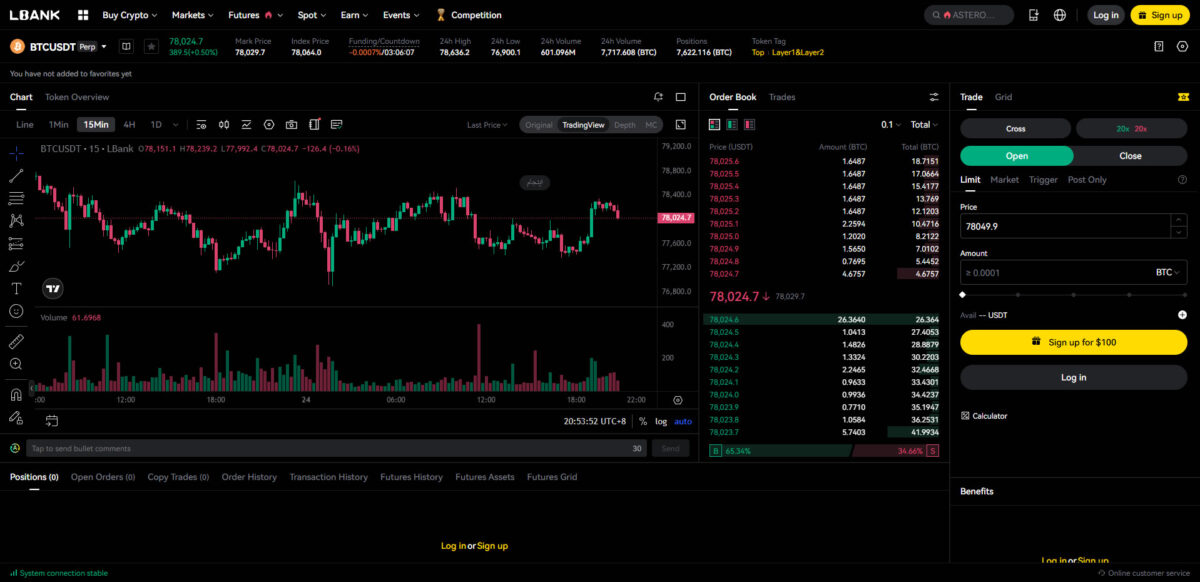
Customization options are rudimentary, allowing traders to adjust chart indicators, timeframes, but not panel layouts. While it may not be as advanced as professional trading terminals, it’s still functional and usable. Most users won’t really notice any downsides or missing features.
Customer Support Channels
LBank offers customer support through several channels, including email support, a ticketing system, social media platforms, and a web-based help center. Live chat support is also available, which is a strong addition for resolving urgent issues more quickly.
The help center is particularly well-developed, covering a wide range of topics from account setup to advanced trading features. It is available in multiple languages, which is not something every exchange supports, and makes the platform more accessible to international users.
Supported Languages
LBank’s website and mobile app are available in the following languages:
Customer support or help center articles may not always be available in all these languages, but the exchange is still very accessible to customers around the world.
6. Safety & Security
Company Info and Overview
LBank has been operating since 2017, which already puts it ahead of many newer exchanges that have not yet been tested over time. The platform has grown steadily and now serves over 25 million registered users6 worldwide, usually ranking within the top 20 exchanges by trading volume.
The company operates globally, with its corporate headquarters in the British Virgin Islands and operational office in Indonesia. It also maintains regional offices in the United States, Canada, Australia, Lithuania, and the United Arab Emirates, which helps support its international user base.
This global presence gives LBank a broader operational footprint than many smaller exchanges. While it is not as centralized as some heavily regulated platforms, it has managed to build a stable presence across multiple regions.
Regulatory Compliance and Licenses
LBank holds a number of regulatory registrations, including basic money transmitter licenses in the United States, Canada, and Australia. It also operates with VASP (Virtual Asset Service Provider) licenses in Italy and Lithuania, which adds an extra layer of legitimacy.
While this level of regulation does not match fully licensed exchanges in major jurisdictions, it is still above average for platforms that offer optional KYC. Many no-KYC or optional-KYC exchanges operate with little to no licensing, so LBank’s regulatory coverage is a notable advantage.
The optional KYC model makes full regulatory compliance more difficult, which explains why its licenses are more limited. Even so, the presence of multiple registrations suggests an effort to operate within legal frameworks where possible.
Available and Restricted Countries
LBank is available in most countries worldwide, but like all exchanges, it restricts access in certain jurisdictions due to regulatory requirements. Users are advised to check the official terms of service7 to confirm availability in their region.
LBank is available in a total of 189 countries, and restricts users from 36 countries. Restricted countries include Afghanistan, Antigua & Barbuda, Azerbaijan, Bangladesh, Belarus, Burkina Faso, Burundi, Canada, Central African Republic, China, Congo - Kinshasa, Cuba, Egypt, Guinea-Bissau, Hong Kong, Iran, Iraq, Kazakhstan, Kyrgyzstan, Lebanon, Lesotho, Libya, Macau, Mali, Mauritania, North Korea, Russia, Somalia, South Sudan, Sudan, Syria, Ukraine, United Arab Emirates, United States, Venezuela, and Yemen.
Restrictions typically apply to countries with strict crypto regulations or sanctions. These limitations are fairly standard across the industry and are not unique to LBank. In most of the world the exchange is fully available, and the platform doesn’t limit any trading markets based on user location or KYC.
Platform and Funds Safety
LBank has maintained a clean security record with no major hacks reported since its launch in 2017. That kind of track record is important, especially in an industry where security breaches are not uncommon.
The platform uses multiple layers of security, including cold and hot wallet separation, encryption protocols, and continuous system monitoring. It has also partnered with CertiK for security audits, smart contract verification, and penetration testing, which adds credibility to its infrastructure.
While LBank does not currently provide proof of reserves, it compensates with operational transparency and external security partnerships. Its global presence and long operating history further support its reputation as a stable platform.
User Account Security
User-level security on LBank is strong and includes all the standard protections expected from a modern exchange. Two-factor authentication is mandatory, adding an extra layer of protection against unauthorized access.
Additional features include withdrawal whitelist options, anti-phishing codes, and an asset password required to confirm transactions. These measures help prevent common attack vectors such as phishing or account takeovers.
Users can also monitor login activity, manage trusted devices, and restrict access through IP whitelisting. Taken together, these tools provide a solid defense against most security threats when used properly.
Is LBank Safe or Unsafe?
LBank falls into the category of reasonably safe exchanges, especially when compared to other platforms with optional KYC. Its long operational history, lack of major security incidents, and partnerships with security firms all work in its favor.
That said, it does not reach the same level of transparency or regulatory oversight as the largest fully licensed exchanges. The absence of proof of reserves may be a concern for some users who prioritize maximum transparency.
Overall, LBank is considered safe for most trading activities, particularly for users who take advantage of its built-in security features. As always, it is wise to avoid storing large amounts of funds on any exchange for extended periods.
7. Conclusion
LBank sits in an interesting spot in the crypto exchange space. It does not try to be the most regulated or the most beginner-focused platform, yet it quietly delivers a wide range of features that appeal to active traders and opportunistic investors. The combination of low fees, diverse markets, and constant promotions gives it a practical edge for users who want variety without juggling multiple platforms.
At the same time, the optional KYC, broad asset selection, and access to both centralized and on-chain markets make it attractive for users who value control and access. It is not perfect, but it offers enough tools and incentives to keep users engaged over the long term.
Who It’s Best For (and Not For)
- Beginners who want easy access to altcoins and simple onboarding
- Active traders looking for low spot fees and frequent promotions
- Users interested in memecoins and early-stage tokens
- Traders who want both crypto and TradFi exposure in one place
- Users who prefer optional KYC and more privacy
- Users who want fully regulated, top-tier licensed exchanges
- Long-term investors seeking advanced wealth management tools
- Beginner investors who need scheduled buying or demo trading
- Users who need direct fiat withdrawals to bank accounts
Final Verdict
LBank proves that a platform does not need massive brand recognition to compete effectively. It focuses on what many users actually want, which is access to a wide range of assets, low trading fees, and constant opportunities to earn bonuses or rewards. That approach makes it especially appealing to active traders and those chasing new market trends.
The exchange does a particularly good job with variety. From spot and futures to on-chain memecoins and TradFi assets, it covers more ground than many competitors in its tier. This makes it a strong option for users who prefer keeping everything under one account rather than splitting funds across multiple platforms.
There are trade-offs, of course. The lack of direct fiat withdrawals can be an inconvenience, and no proof of reserves may raise concerns for more cautious users. It also lacks some of the advanced account management features that professionals or institutions might expect.
Even with those limitations, LBank holds its own as a reliable and feature-rich exchange. It works best for users who value access, variety, and low fees over strict regulation and polished extras. For the right type of trader, it can easily become a go-to platform.
Sources and references:

All reviews submitted are moderated. Negative opinions are fine. Spam, competitor promotion, false claims, FUD or unsubstantited criticism is not approved.