






Exchange Overview
Kraken is one of the longest-running and most trusted crypto exchanges in the industry. Founded in 2011, it focuses heavily on security, regulatory compliance, and a professional trading environment. That approach has earned it a loyal user base, especially among traders who value reliability over flashy features.
The platform’s highlights include deep liquidity and broad market access, covering not only cryptocurrencies but also an expanding range of traditional financial assets. Kraken has steadily pushed into TradFi territory, offering stock trading and tokenized equities alongside crypto. This hybrid model makes it one of the more versatile exchanges available today.
Another key strength lies in its global reach and regulatory footprint. Kraken operates in multiple major jurisdictions, including the United States and the European Union, with licenses that allow it to offer both spot and derivatives trading. This level of compliance adds a layer of trust that many newer exchanges struggle to match.
At the same time, Kraken leans more toward experienced users than casual beginners. The default interface is easy to use, but switching to the Pro version unlocks the full beast. Overall, it’s both a serious trading platform and a beginner-friendly on-ramp.
- Strong regulatory compliance across multiple regions
- Excellent security track record with no major breaches
- Wide range of markets including crypto, stocks and tokenized equities
- Reliable fiat on-ramps with many direct payment methods
- Professional-grade trading interface
- High spot trading fees compared to competitors
- Limited fee discount options
- Missing features like copy trading and bots
- Strong regulatory compliance results in more restrictions to loans, staking or derivatives trading
- No P2P market or gateways to fill gaps in fiat deposits
Cash Deposits and Withdrawals
Kraken supports a wide range of direct fiat payment methods, which usually removes the need for third-party gateways. Users can fund their accounts using debit and credit cards, ACH transfers, SEPA payments, SWIFT wires, and even modern options like Apple Pay and Google Pay. PayPal is also available in certain regions, along with localized bank transfers in countries like Brazil, Canada, and Australia.
| Payment method | Supported currencies | Deposit fee | Withdrawal fee |
|---|---|---|---|
| Visa and Mastercard | Any supported | 3.75% + €0.25 | Not available |
| Google Pay | Any supported | 3.75% + €0.25 | Not available |
| Apple Pay | Any supported | 3.75% + €0.25 | Not available |
| ACH bank transfer | USD | Free | Free in USA, $35 worldwide |
| SEPA bank transfer | EUR | Free in EU, €3 worldwide | €1 in EU, €5 worldwide |
| SWIFT bank transfer | Any supported | $3 CAD, USD or GBP, 0.75 CHF | 14 to 35 USD |
| PIX | BRL | 0.50% | Not available |
| PayPal | Any supported | 5% (min. $1/€1) (US, EU, UK, AUS) | Not available |
Fiat withdrawals are more limited, as they are only available via bank transfers. However, the fees for withdrawals are generally low and predictable, which appeals to users who prioritize cost efficiency. Processing times vary depending on the method, but SEPA and domestic transfers are typically faster than international wires.
The absence of third-party payment processors and a P2P marketplace might sound limiting at first. In practice, Kraken covers most user needs through its native payment rails, which tend to be faster and more secure. This direct approach also reduces friction during onboarding and keeps transactions within the platform’s ecosystem.
Trading Markets and Fees
Crypto Trading Markets
- Spot Trading: Kraken offers a wide selection of crypto pairs with strong liquidity. Spot trading is straightforward and supports various order types, making it suitable for both beginners and advanced users.
- Margin Trading: Users can access leveraged positions on select pairs. While not the most extensive margin offering in the industry, it provides enough flexibility for moderate leverage strategies.
- Futures Trading: Kraken Futures delivers a more advanced trading environment with competitive leverage and professional-grade tools. It is well-suited for experienced traders who need derivatives exposure.
- TradFi Markets: This is where Kraken really expands its scope. Users can trade traditional stocks, stock futures, and tokenized equities directly on the platform. Kraken also owns xStocks, enabling tokenized stock trading on spot markets, which bridges crypto and traditional finance in a unique way.
- Onchain Trading: On-chain token trading is available on Kraken app to customers in USA and over 100 other countries. This enables customers to trade thousands of Solana-based tokens without needing separate wallets.
Kraken does not offer delivery futures or options trading, which may disappoint advanced derivatives traders. Still, its overall market coverage remains one of the most comprehensive in the industry.
Trading Fees
- Kraken’s spot trading fees start at 0.40% maker and 0.80% taker, which is noticeably higher than the industry average (between 0.1% and 0.2%). This makes it less attractive for frequent traders who rely on tight margins.
- Futures fees are more competitive, set at 0.02% maker and 0.05% taker, which aligns with industry standards.
High-volume traders can access VIP discounts, starting at $2,500 in 30-day volume for spot or $5M for futures, or alternatively $20,000 in account balance. There are no native token discounts, referral-based fee reductions, or signup bonuses that lower trading costs. This limits the ways users can reduce fees, especially compared to competitors that offer multiple discount mechanisms.
Due to high default fees2 and limited ways to reduce them, Kraken is rarely a top choice for high-volume crypto traders. It’s good as a fiat on-ramp and regulated Futures trading, but Spot fees can be disastrous for profits.
Other Trading Features
Kraken lacks several features that have become standard on competing platforms. There is no demo trading or copy trading to help beginners get started with trading. Built-in trading bots are also missing, which may frustrate more advanced users. Subaccounts technically exist, but only for certain users, and require contacting support to set up2.
Additionally, Kraken does support onchain trading, but unfortunately only Solana chain is supported3. No other DeFi integrations directly within the platform exist. This creates a more closed ecosystem compared to exchanges that embrace Web3 functionality.
Additional Financial Features
- Staking: Kraken offers on-platform staking for a variety of assets, allowing users to earn passive rewards. The process is simple and integrated directly into the account dashboard.
- ATM Card: Kraken provides a crypto debit card in select regions, enabling users to spend their crypto balances in everyday transactions. It adds a layer of real-world utility to held assets.
- Prop Accounts: The platform does currently offer proprietary trading accounts or funded trader programs. Not many exchanges in the industry have this feature, but caution is still advised despite smaller initial investment requirement.
- Web3 Wallet: Kraken developed one of the most secure Web3 wallets, allowing users to interact with decentralized applications. While still developing, it signals a move toward broader ecosystem integration.
Kraken lacks features like advanced yield products, which limits its appeal for users seeking a full financial hub, but plenty of other features mentioned make up for any gaps. Most users will not truly notice anything missing.
User Experience
Kraken delivers a stable and consistent user experience that favors reliability over flash. The platform rarely suffers from outages, even during high volatility, which already puts it ahead of many competitors. That said, it expects users to put in a bit of effort to understand how things work.
The biggest difference comes down to interface choice. Kraken separates its basic interface from its Pro trading platform, and users who stick to the default version often miss out on better tools. Switching to Kraken Pro is almost essential for anyone planning to trade actively.
There is a clear focus on function over form. While the design is clean, it avoids unnecessary visual elements and prioritizes usability. For some users that feels efficient, while others may find it slightly dated compared to newer exchanges.
Overall User Experience
Kraken’s overall experience feels polished and dependable, with very few technical hiccups. Navigation is straightforward once users get familiar with the layout, and most actions can be completed without unnecessary steps. Deposits, withdrawals, and transfers between wallets are handled smoothly.
Customization options are available, especially within the Pro interface. Users can adjust chart layouts, reorder modules, and tailor their dashboard to fit their trading style. This flexibility helps more experienced traders create a workspace that suits their workflow.
Educational content is another strong point. Kraken offers in-depth guides, explainers, and onboarding materials that help users understand both the platform and broader crypto concepts. While not as interactive as some competitors, the content is clear and genuinely useful.
Trading User Interface
The trading interface on Kraken Pro is built with experienced users in mind. It includes advanced charting tools, depth charts, and a full order book view. This makes it easier to analyze market conditions and execute trades with precision.
Order types cover most needs, including market, limit, stop-loss, and take-profit orders. The interface allows for quick switching between trading pairs and efficient order placement. Once learned, the workflow feels fast and logical.
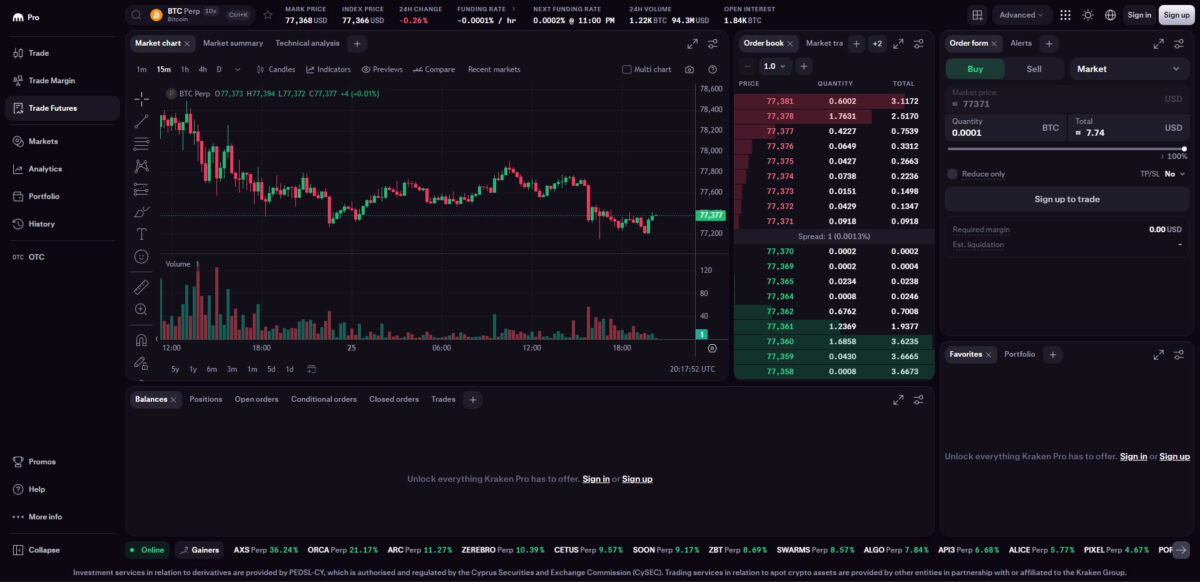
That said, beginners may feel overwhelmed at first. The amount of data on screen can be intimidating, especially for those new to trading. However, users who invest a bit of time usually find the interface becomes intuitive.
Customer Support Channels
Kraken provides multiple support channels4, which is still not a given in the crypto space. Users can contact support through email tickets and a structured help center that covers most common issues. The documentation is detailed and often answers questions without needing direct contact.
Live chat is available and generally responsive, especially for basic inquiries. More complex issues may take longer to resolve, depending on the nature of the request. Response quality is usually solid, though wait times can vary during peak periods.
Phone support is offered in certain regions, which adds an extra layer of accessibility. Kraken also maintains active social media channels where users can get updates and occasional assistance. Overall, support is reliable, even if not the fastest in every case.
Supported Languages
Kraken supports multiple languages, making it accessible to a global audience. The platform interface is translated into several major languages, which helps non-English speakers navigate the system more comfortably. This is especially important given its wide international user base.
Currently supported languages (13):
Language support extends beyond the interface to include help center articles and guides. This ensures that users can find assistance in their preferred language, rather than relying on translations. It improves usability for those less confident in English.
Safety & Security
Company Info and Overview
Kraken has operated since 2011, which makes it one of the oldest surviving crypto exchanges still active today. That kind of longevity is rare in crypto, where many platforms disappeared during the first few market cycles. It shows a strong internal structure and a consistent focus on risk management.
The company was founded by Jesse Powell, who positioned Kraken early on as a security-first exchange. Instead of chasing rapid expansion, the platform focused on building infrastructure that could withstand both market volatility and external threats. That philosophy still shapes how Kraken operates today.
Kraken is privately owned and headquartered in United States, with a global operational footprint. It has expanded steadily over the years through both organic growth and acquisitions, buying multiple firms in the derivatives and regulatory space. This steady, measured expansion has helped it avoid many of the pitfalls that affected more aggressive competitors.
Regulatory Compliance and Licenses
Kraken maintains one of the broadest regulatory footprints in the crypto industry. It is registered and licensed in multiple jurisdictions5, including the United States, Canada, United Kingdom, Australia, UAE, and multiple countries across Europe. This allows it to legally offer a wide range of services, from spot trading to regulated derivatives.
In the European Union, Kraken complies with MiCA and MiCAR frameworks, which govern crypto asset markets and service providers. These licenses allow it to operate under clear regulatory guidelines, including derivatives trading, which remains restricted on many other regulated platforms. This gives Kraken a notable advantage in regulated markets.
Regulatory compliance also means stricter onboarding procedures, including identity verification and transaction monitoring. While some users may find this inconvenient, it significantly reduces the risk of fraud and platform misuse. In practice, it positions Kraken as a more transparent and accountable exchange compared to loosely regulated competitors.
Available and Restricted Countries
Kraken is available in a large majority of countries worldwide, making it one of the more accessible exchanges globally. Its regulatory licenses allow it to serve users across North America, Europe, and parts of Asia-Pacific without major restrictions. This wide coverage is a key reason for its large and diverse user base.
Kraken is available in a total of 212 countries, and restricts users from 13 countries. Restricted countries include Afghanistan, Belarus, Congo - Kinshasa, Cuba, Iran, Iraq, Japan, Libya, North Korea, Russia, South Sudan, Sudan, and Syria.
Restrictions are mainly limited to sanctioned or high-risk jurisdictions. Countries subject to international sanctions or lacking clear regulatory frameworks for crypto trading are typically excluded. This includes regions flagged for anti-money laundering concerns or geopolitical restrictions.
In some supported countries, certain features may still be limited. For example, derivatives trading or staking might not be available everywhere due to local regulations. Despite these limitations, all have access to core features like spot trading and fiat payments.
Platform and Funds Safety
Kraken uses a cold storage system to secure the majority of user funds, keeping them offline and away from potential cyberattacks. Only a small portion of assets is held in hot wallets to facilitate daily operations. This significantly reduces the risk of large-scale breaches.
The platform also implements proof of reserves6, allowing users to verify that their funds are fully backed. This transparency has become increasingly important after several high-profile exchange collapses in recent years. Kraken’s approach helps build trust by giving users visibility into asset backing.
In terms of track record, Kraken has not experienced any major exchange-wide hacks. It runs regular security audits, maintains an active bug bounty program, and works with external researchers to identify vulnerabilities. These layered defenses7 create a strong overall security posture. There’s zero reasons to think Kraken is unsafe.
User Account Security
Kraken offers a wide range of account-level security features designed to protect users from unauthorized access. Two-factor authentication is strongly encouraged and can be applied to login, trading, and withdrawals. This adds a critical layer of protection against compromised credentials.
Users can also enable withdrawal whitelists, which restrict withdrawals to pre-approved wallet addresses. Anti-phishing codes are available to help users verify official Kraken communications and avoid scams. A global settings lock can prevent unauthorized changes to account details.
More advanced features include support for passkeys, which provide a modern alternative to traditional passwords. While Kraken does not use separate trading or fund passwords, its overall security system remains robust. Combined with user awareness, these tools provide strong protection against most common attack vectors.
Conclusion
Kraken is one of the most reliable and regulated exchanges in the crypto space. It focuses on trust, security, and long-term stability rather than flashy features.
Who It’s Best For (and Not For)
- Beginners: Suitable, but requires some learning effort
- Futures traders: Good fit for futures trading with competitive fees
- Passive investors: Solid staking options for earning on holdings
- Security-focused users: Strong track record and robust protections
- TradFi traders: Access to stocks, futures, and tokenized equities
- Active spot traders: Less ideal for spot trading due to high fees
- Advanced traders: Missing features like bots and subaccounts
- DeFi users: Limited Web3 and onchain integration
- Fee-sensitive users: Few discounts or ways to reduce trading costs
Final Verdict
Kraken plays a different game than most exchanges. It focuses on trust, compliance, and stability, which makes it a safe choice in a volatile industry. That approach won’t excite users chasing the latest features, but it builds long-term confidence.
Its expansion into traditional finance is a smart move. By offering stocks, tokenized equities, and futures alongside crypto, Kraken creates a more complete trading ecosystem. Few competitors match that level of integration, especially in a fully regulated environment.
That said, the platform is not perfect. High spot fees and a lack of modern features like copy trading or automation tools hold it back. Active traders may find better value elsewhere, especially if cost is a priority. Regulatory compliance also has its downsides, so certain countries are often restricted from derivatives markets or staking.
In the end, Kraken is perfect for users who value security and regulation over bells and whistles. It may not be the flashiest exchange, but it gets the fundamentals right.
Sources and references:
- Kraken Pro fee schedule – https://www.kraken.com/features/fee-schedule ↩︎
- Subaccounts and API keys – https://blog.kraken.com/product/api/unlocked-6-multi-strategy-operations-subaccounts-api-keys ↩︎
- On-chain token trading – https://blog.kraken.com/product/onchain-trading/now-built-into-the-kraken-app ↩︎
- Support center – https://support.kraken.com ↩︎
- Where is Kraken licensed or regulated – https://support.kraken.com/hc/en-us/articles/where-is-kraken-licensed-or-regulated ↩︎
- How to verify your account balance – https://support.kraken.com/articles/203250213-how-to-verify-your-account-balance ↩︎
- Industry-leading security protects your investments – https://www.kraken.com/features/security ↩︎

All reviews submitted are moderated. Negative opinions are fine. Spam, competitor promotion, false claims, FUD or unsubstantited criticism is not approved.