














1. Exchange Overview
Coinbase is one of the most recognizable names in the crypto industry, often seen as the entry point for first-time users. Founded in 2012 and based in the United States, it built its reputation on simplicity, regulatory compliance, and strong ties to traditional finance. The platform focuses heavily on ease of use, making it accessible even for users with no prior trading experience.
One of Coinbase’s biggest strengths is its direct integration with fiat payment systems. Users can deposit and withdraw funds using familiar banking methods, without relying on third-party gateways or peer-to-peer markets. This makes onboarding straightforward in supported regions, but it also means users in less supported countries may face limitations when trying to fund their accounts.
The exchange also leans heavily into regulatory compliance, operating under licenses in multiple jurisdictions. This approach adds a layer of trust and transparency, especially compared to offshore exchanges. At the same time, it introduces trade-offs, as certain features like derivatives and staking may be restricted depending on the user’s location.
Despite its strong reputation, Coinbase is not built as a comprehensive trading platform. Its core focus remains accessibility rather than advanced trading tools or low fees. As a result, it often serves better as a gateway into crypto rather than a long-term trading destination.
- Strong regulatory compliance and global licensing
- Easy fiat deposits and withdrawals with many supported methods
- Beginner-friendly interface with educational resources
- Reliable security practices and public company transparency
- Wide availability across many countries
- Extremely high spot trading fees compared to competitors
- Limited advanced trading tools and features
- No margin or options trading
- Feature availability varies heavily by region
- No fee discounts via native token or referral codes
- Lacks tools like bots, copy trading, and subaccounts
2. Payment Methods and Fees
Coinbase offers a wide range of direct fiat payment options, making it one of the most accessible exchanges globally for converting traditional currency into crypto. Supported methods include credit and debit cards, ACH transfers in the United States, SEPA transfers in Europe, and SWIFT for international bank wires. Users can also pay through modern options like Google Pay, Apple Pay, and PayPal, depending on their region.
| Payment method | Supported currencies | Deposit fee | Withdrawal fee |
|---|---|---|---|
| Visa and Mastercard | Any supported | 3.99% | 3.99% (EU, US, UK) |
| Google Pay | Any supported | 3.99% | Not available |
| Apple Pay | Any supported | 3.99% | Not available |
| Samsung Pay | Any supported | Supported in US&CA, unknown fee | Not available |
| ACH bank transfer | USD | Free | Free |
| SEPA bank transfer | EUR | €0.15 | Free |
| SWIFT bank transfer | Any supported | GBP free, USD $25 | £1 GBP, $25 USD |
| Faster Payments bank transfer | GBP | Free | Free |
| PIX | BRL | $10 | $25 |
| FAST bank transfer | SGD | Supported, unknown fees | Not available |
| PayPal | Any supported | 2.49% | 1% |
In addition to mainstream methods, Coinbase supports localized bank transfer systems such as PIX in Brazil, FAST in Singapore, FPS in the UK, IMPS in India, and Interac in Canada. These integrations help reduce friction for users in supported regions and often provide faster settlement times or lower costs compared to international wires.
Fees for fiat transactions vary widely depending on the method used and the user’s region. Card purchases tend to carry higher fees due to processing costs, while bank transfers are usually cheaper or even free for deposits. Withdrawal fees also depend on the method, with bank wires typically costing more than local transfer systems.
A key limitation is the absence of third-party fiat gateways and a P2P marketplace. While this improves transparency and reduces counterparty risk, it can create challenges for users in countries with limited banking access. Without alternative funding methods, some users may find it difficult to deposit funds, instead having to rely on bank cards which have fairly high fees.
3. Markets, Fees and Features
Crypto Trading Markets
Coinbase offers several types of trading markets, though its selection is more limited compared to large global derivatives exchanges.
- Spot Trading: This is the core offering, allowing users to buy and sell cryptocurrencies directly. The interface is simple and geared toward beginners, though it lacks depth compared to professional trading platforms. Liquidity is strong on major pairs, but smaller assets may have wider spreads.
- Futures Trading: Coinbase provides access to crypto futures in certain regions, mainly through regulated entities. These contracts allow users to speculate on price movements with leverage, but availability is heavily restricted due to compliance requirements. Many users will not have access to this feature depending on their country, and max leverage is dynamic based on location, asset, and time of day1.
- Onchain Trading: Through its wallet and Web3 integrations, Coinbase enables users to interact with decentralized applications and trade assets directly on blockchain networks. This expands access beyond centralized order books, though it introduces blockchain fees and additional complexity.
There is no margin trading or options trading available on Coinbase. Some users may find limited access to commodities like oil or metals, but the selection is small and often restricted to specific jurisdictions. Stocks and indice trading is available with a wide range of assets, but only for users based in the United States. Nowadays, many crypto exchanges have more extensive TradFi offering.
Trading Fees
Coinbase’s spot trading fees are among the highest in the industry. The standard structure starts at around 0.60% for makers and 1.20% for takers, which is significantly higher than most competing exchanges. In many cases, this can be more than ten times the cost of trading on lower-fee platforms, making it an expensive choice for active traders.
Average spot trading fees on other exchanges are 0.20% for all order types (maker or taker), with many platforms offering merely 0.10% fees. Coinbase spot fees are minimum 0.60% and up to 1.20%!
Futures trading fees are more competitive, typically around 0.02% for makers and 0.04% for takers. While these rates are relatively low, access to futures markets is frequently limited due to regulatory restrictions. As a result, many users cannot take advantage of these lower fees.
Coinbase offers VIP tiers based on trading volume and account balances, which can reduce fees over time. However, some of the requirements are relatively high, and discounts may not be significant enough to compete with other exchanges. Unlike many platforms, Coinbase may also assign different fee structures to users based location or account activity, which reduces transparency.
Fees can depend on user location. For most accurate fees users need to check the fees page2 while logged in.
There is no native token that provides fee discounts, and referral programs do not offer any rebates. Overall, users are expected to pay a premium for the platform’s regulatory compliance and ease of use. That’s usually fine for inexperienced retail users, but a deal breaker for more experienced investors.

A decent signup bonus is available with our referral code, requiring certain trading volume on Coinbase Advanced. Trading $100 awards $5, trading $5,000 awards $20, and trading $10,000 within two weeks awards extra $50 spot (in stablecoins).
Other Trading Features
Coinbase includes a few additional trading-related features, though the overall toolkit remains limited compared to advanced platforms.
- Leveraged tokens are available in some regions, offering simplified exposure to leveraged positions without managing margin directly.
- The NFT marketplace allows users to explore and trade digital collectibles, though activity levels vary.
- A built-in Web3 wallet enables interaction with decentralized applications and onchain assets.
At the same time, several commonly expected features are missing. There is no demo trading environment, copy trading, or integrated trading bots. Users also do not have access to scheduled buying tools or subaccounts, which may limit options for more advanced strategies.
Financial Features and Services
Coinbase offers a small set of additional services beyond trading, though the selection leans more toward basic financial tools rather than advanced crypto features. The platform focuses on simplicity and compliance, which shows in the limited but straightforward product lineup. Most features are designed for accessibility rather than depth.
- Loans: Users in select regions can borrow funds against their crypto holdings. Typically, this involves using assets like Bitcoin as collateral to receive fiat or stablecoins. The feature is not widely available to all customers, and terms can vary depending on jurisdiction and regulatory approval.
- Staking: Users can stake supported cryptocurrencies directly through the platform and earn rewards. Coinbase handles the technical side, making it simple for beginners, but it takes a commission on rewards. Staking availability depends on local regulations, and some users may not have access at all. Only onchain staking is available, which in some cases has long unstaking periods.
- ATM Card: The Coinbase Card allows users to spend crypto balances in real-world transactions. It works like a debit card and supports multiple cryptocurrencies, converting them to fiat at the point of purchase. While convenient, fees and supported regions vary, and not all users can apply.
There are no signup bonuses or meaningful reward programs aimed at reducing trading fees. Unlike many competitors, Coinbase does not rely on aggressive promotions to attract users. This keeps the experience clean, but it also removes potential cost-saving opportunities for active traders.
4. User Experience
Coinbase keeps things simple, sometimes to a fault. The platform is clearly built for accessibility first, which works well for beginners but may feel limiting for experienced users. Navigation is clean, and most features are easy to find without digging through menus.
Overall User Experience
The interface is straightforward, with a clear focus on guiding users through buying, selling, and managing crypto. Educational content and tutorials are built into the platform, helping new users understand basic concepts without leaving the site. This makes it one of the more beginner-friendly exchanges available.
We highly recommend turning on Coinbase Advanced mode. It may require a small learning curve, but results in better options and lower fees.
Customization options are excellent on Coinbase Advanced, especially compared to other trading platforms. Users can completely modify layouts, and all trading panels can be moved, removed or resized according to user preferences. Those who need simplicity can go back to Coinbase’s basic mode, or simply turn off unnecessary panels in Advanced.
A full dark theme is available across both the trading interface and account dashboard. This small detail improves usability during extended sessions and is a welcome addition, especially since some competing platforms still treat dark mode as an afterthought.
Trading User Interface
The trading interface is clean and easy to understand, but it can lack depth for expert traders. Basic order types such as market and limit orders are available, along with stop limit and TWAP. More advanced tools like conditional orders, Iceberg or grid bots for more complex strategies are limited or absent. This keeps things simple, but restrictive for advanced traders.
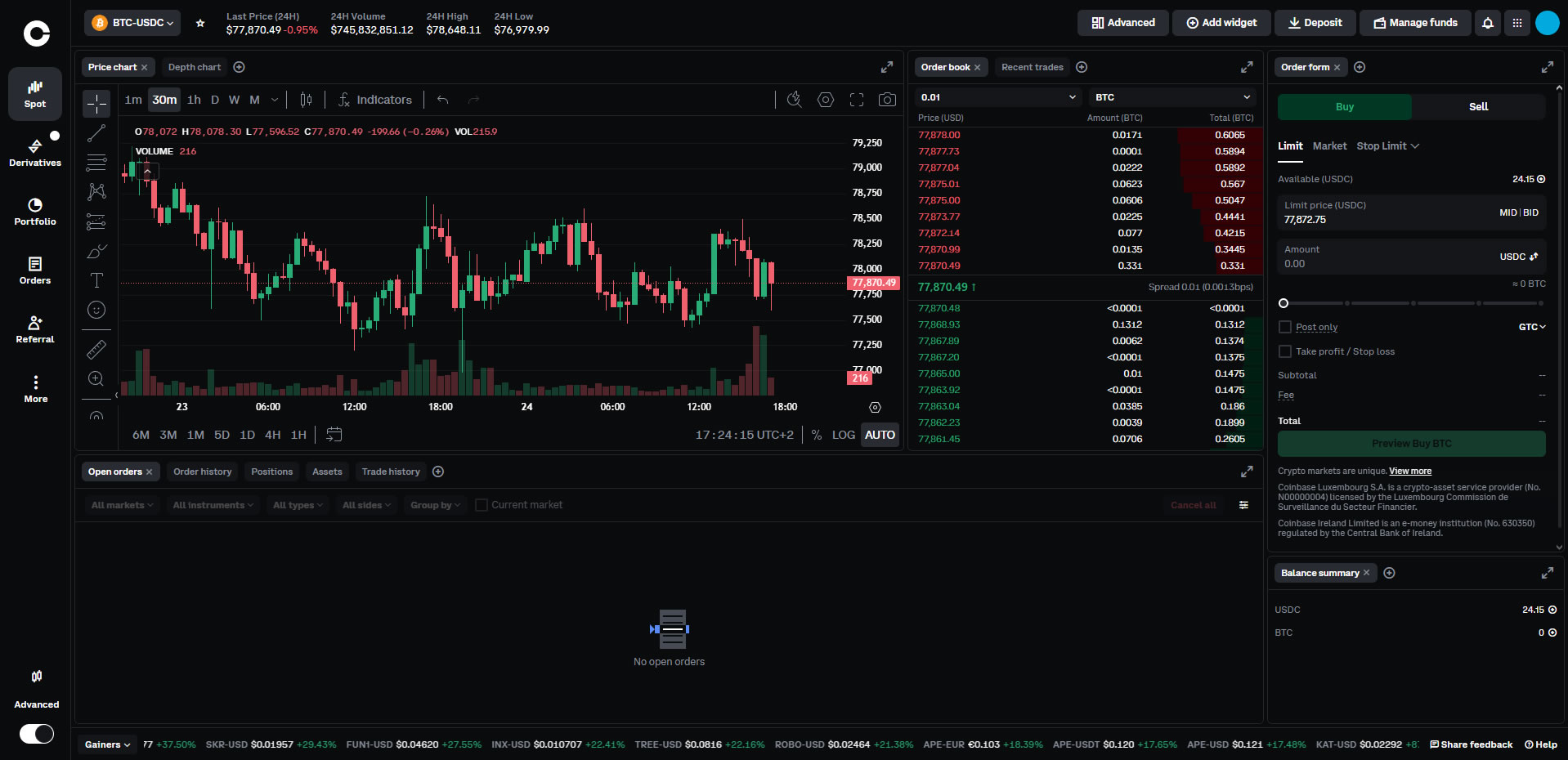
Charts are functional and powered by TradingView, so all advanced indicators are available directly in the trading interface. Many traders end up using external charting platforms instead, but there’s often no need for it.
Overall usability is solid for straightforward trades, but the interface doesn’t always scale well for high-frequency or complex strategies. It works best for occasional trades rather than active portfolio management.
Customer Support Channels
Coinbase provides several customer support options, including email support, a web-based help center, and ticketing systems. A live chat feature is also available, though response times can vary depending on demand. Phone support exists for specific issues, mainly related to account security.
The help center is extensive and covers most common issues with clear documentation. Users can often resolve problems without contacting support directly, which reduces friction for simple queries. Social media channels are also used for updates and communication, though they are not a primary support method.
Response quality is generally acceptable, but delays are not uncommon during periods of high market activity. This has been a recurring complaint among users, especially when dealing with urgent account issues. Quick checks on social media reveal far more complaints about Coinbase’s customer support than any other exchange, but some of it can likely be attributed to its large (and generally inexperienced) user base.
Supported Languages
5. Safety & Security
Company Info and Overview
Coinbase operates as a publicly traded company in United States, which adds a level of transparency not seen with many crypto exchanges. Financial disclosures, audits, and regulatory filings are part of its regular operations. This makes it easier for users to assess the company’s financial health and risk exposure.
This exchange aims to be a bridge between traditional finance and crypto. Its numerous partnerships with banks and institutional players reinforce this role. While this approach builds trust, it also shapes the platform into a more conservative and regulated environment.
Over the years, Coinbase has maintained a relatively stable reputation compared to many competitors. It has avoided major scandals or collapses, though it has faced criticism over outages during high volatility periods. These incidents highlight operational challenges rather than systemic risks.
Regulatory Compliance and Licenses
Coinbase is one of the most heavily regulated crypto exchanges globally. It holds individual licenses in over 40 U.S. states, and is fully licensed and operates in countries such as the United Kingdom, Canada, Australia, Singapore, and India. Within Europe, it maintains multiple national licenses and has secured MiCA authorization for broader EU operations. Thanks to MiFID license in the United Kingdom3, residents can even trade derivatives and equities, which is a rarity in the regulated exchange space.
This level of compliance provides a strong legal foundation and makes Coinbase a trusted option for institutions and retail users alike. It also ensures adherence to strict standards around anti-money laundering and consumer protection. For many users, this is a key reason to choose the platform.
However, regulatory compliance comes with trade-offs. Features like derivatives trading and staking are often restricted or unavailable depending on user location. This can make the platform feel inconsistent across regions and limits access to some advanced features.
Available and Restricted Countries
Coinbase is available in a large number of countries, with relatively few outright restrictions. Most limitations apply to regions under international sanctions or those with strict crypto regulations. This broad availability makes it one of the more accessible exchanges globally.
That said, feature availability varies significantly by country. Users in certain regions may only have access to basic buying and selling, while others can use a wider range of services. This creates an uneven experience depending on location.
Coinbase is available in a total of 205 countries, and restricts users from 20 countries. Restricted countries include Afghanistan, Belarus, Central African Republic, Congo - Brazzaville, Congo - Kinshasa, Cuba, Ethiopia, Iran, Iraq, Lebanon, Libya, Myanmar, North Korea, Somalia, South Sudan, Syria, Turkey, Venezuela, Yemen, and Zimbabwe.
In general, users should check their local availability before signing up. Even if the platform is accessible, specific features like staking or derivatives may not be supported in their jurisdiction.
Platform and Funds Safety
Coinbase stores the majority of user funds in cold storage, reducing exposure to online threats. Only a small portion of assets is kept in hot wallets for operational liquidity. This approach aligns with industry best practices and minimizes risk in case of a breach.
The platform also maintains insurance coverage for certain types of losses, particularly those related to custodial funds held online. While this does not cover all scenarios, it provides an additional layer of protection. Coinbase has also implemented bug bounty programs and undergoes regular security audits.
In terms of history, Coinbase has not experienced a major exchange-wide hack affecting customer funds. However, individual account compromises have occurred, often due to phishing or weak user security practices. Because of this it’s important to activate proper account security measures.
User Account Security
Coinbase offers standard account security features such as two-factor authentication, login alerts, and device verification. Users receive notifications for account activity, which helps detect unauthorized access early. These features are easy to set up and widely used.
Additional protections include withdrawal address whitelisting and account recovery processes. These tools add layers of defense, especially for users holding significant balances. The platform also encourages strong password practices and secure authentication methods.
Some advanced security features found on other exchanges are missing. There are no trading PINs or withdrawal passwords, which could add extra protection for sensitive actions. Strangely, there’s no anti-phishing codes either. Even so, the overall security offering is solid and sufficient for most users.
6. Conclusion
Coinbase works best as a simple, regulated entry point into crypto. It does not try to compete with advanced trading platforms, and that shows in both its feature set and pricing. The platform is reliable for basic use, but it starts to feel limited once trading activity (or experience) increases.
The platform is most useful as a fiat on-ramp and off-ramp. Users can deposit funds easily, buy crypto, and withdraw back to their bank without much friction. However, due to high trading fees, it is a poor choice for frequent trading or active strategies.
Many users end up using Coinbase for its accessibility, then moving assets to other exchanges for trading. The lack of advanced tools like trading bots or copy trading reinforces this pattern. For simple use, it does the job, but it’s not built for efficiency, and certainly not for cost-effectiveness.
Who It’s Best For (and Not For)
- Beginners: Simple interface and easy fiat access make onboarding smooth
- Passive investors: Works well for buying, holding, and basic staking
- Users in regulated markets: Strong compliance and licensing provide added trust
- Active traders: High fees and limited tools reduce efficiency
- Advanced traders: Lacks customization and advanced trading features
- Users needing full feature access: Regional restrictions can limit functionality
Final Verdict
Coinbase has a reputation of trust, simplicity, and regulatory compliance. It’s one of the few exchanges that traditional finance users feel comfortable using, and that alone gives it a strong position in the market. The platform does not try to be everything, which helps it stay focused but also limits its appeal.
The biggest downside is cost. Trading fees are significantly higher than most competitors, which quickly adds up for anyone making frequent trades. While beginners may not notice at first, active users will feel the difference almost immediately.
Feature limitations are another factor. Coinbase covers the basics well, but it lacks many tools that experienced traders expect. This includes everything from automation features to more advanced order types, which are standard elsewhere.
Still, Coinbase does exactly what it is designed to do. It provides a clean, regulated, and accessible way to enter and exit the crypto market. For many users, that is enough, but for anything beyond that, it usually becomes a stepping stone rather than a long-term home.
- Leverage and margin rates: https://help.coinbase.com/en/coinbase/derivatives/us-derivatives-leverage-margin ↩︎
- Coinbase Fee Schedule: https://www.coinbase.com/advanced-fees ↩︎
- Coinbase Obtains MiFID License in the United Kingdom: https://www.coinbase.com/blog/coinbase-obtains-mifid-license-in-the-united-kingdom ↩︎

All reviews submitted are moderated. Negative opinions are fine. Spam, competitor promotion, false claims, FUD or unsubstantited criticism is not approved.